Show content of Salomonsohn, Adolph
| Biographical data: | 19.03.1831 in Hohensalza - 04.06.1919 in Berlin | 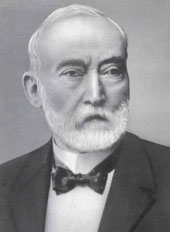 |
| Institution: | Disconto-Gesellschaft | |
| Functions: | Joint Proprietor 1869-1888 |
With three leading managers the Salomonsohn family helped shape the development of Disconto-Gesellschaft for sixty years (1869-1929).
The first among them was Adolph Salomonsohn. He came from an old rabbinical family and belonged to the first generation to pursue a secular career. After studying law, he worked as an assessor and guardianship judge in Berlin, where David Hansemann became aware of him when Salomonsohn substituted for the counsel of the Disconto-Gesellschaft in some legal work.
In July 1863, he joined the Disconto-Gesellschaft as counsel, having given up a position as a notary in Cosel that he had already taken up. In 1866 he received power of attorney and as early as 1869 he was admitted to the circle of partners. In his capacity as a lawyer and merchant banker, Salomonsohn seized the opportunity to give the young German joint-stock bank business a suitable framework. "The business conditions of joint-stock banks, the legal construction of syndicate business and the treatment of share trading were decisively influenced by him." (Georg Solmssen).
His special inclination was also directed towards the financing of railway construction; for example, Disconto-Gesellschaft was substantially involved in the construction of the Gotthard railway. During construction, a new cost plan was drawn up in 1876, which included huge additional requirements and brought the project close to failure. In tough negotiations, Salomonsohn succeeded in greatly reducing the financial volume and getting the governments of Switzerland, Germany and Italy to share in the additional costs, as well as persuading the shareholders to make the outstanding payments on their shares.
In other cases, too, Salomonsohn proved to be a reliable damage limitation expert: early on, Disconto-Gesellschaft pursued the principle of subsidiary banks in Germany by setting up a special Provinzial-Disconto-Gesellschaft. When one of these limited partners, the Frensdorff bank in Hanover, got into difficulties due to bad speculation, Salomonsohn temporarily moved there in order to liquidate the bank without harming the parent company.
He also earned considerable merits in the business with government bonds, whereby he succeeded in placing Prussian, Bavarian and Baden papers on a large scale. He was the founder and first head of Stempelvereinigung, the association of Berlin banks and bankers created for the uniform regulation of stamp tax issues and business conditions. His friendship with Emil Kirdorf, one of the key figures in Rhenish-Westphalian heavy industry, led to close ties with the coal and iron industries, especially with Gelsenkirchener Bergwerks-AG.
In 1888 he withdrew from the management of Disconto-Gesellschaft - of which, however, he was still a member of the supervisory board until his death - and devoted himself intensively to philosophical and scientific studies. Unlike his son Georg Solmssen, Adolph Salomonsohn held on to his Jewish origins throughout his life, which he tried to combine with his patriotic attitude (towards Germany but not towards Kaiser Wilhelm II).
Show content of Salomonsohn, Arthur
| Biographical data: | 03.04.1859 in Hohensalza - 15.06.1930 in Berlin | 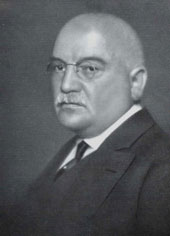 |
| Institution: | Disconto-Gesellschaft / Deutsche Bank | |
| Functions: | Joint Proprietor / Member of the Management Board 1895-1929 |
When Adolph Salomonsohn left the management of Disconto-Gesellschaft in 1888, his nephew Arthur Salomonsohn joined the bank as legal counsel. "His career resembled that of his uncle, even though the two men were very different by nature. Adolph gnarled and robust, Arthur, on the other hand, reserved and conciliatory, a dutiful but cool businessman." (Kurt Zielenziger).
Like Adolph Salomonsohn, Arthur first worked as a court assessor in Berlin after studying law, before joining Disconto-Gesellschaft. Already in 1895, he became a personally liable partner and in 1912, as successor to Alexander Schoeller, he was appointed head of the board of managing partners. He thus also took over the responsibilities of his predecessor, which had mainly encompassed the area of international financing. For example, he represented the interests of Disconto-Gesellschaft in loan negotiations in South America. When, for instance, Argentina had run into payment difficulties due to reckless proliferation of paper money, Salomonsohn succeeded in tenacious negotiations with the authorities there in successfully asserting the claims of German creditors.
The successful development of this company, already founded by Adolph von Hansemann, was due to his work on the administrative board of the Neu-Guinea-Compagnie. In domestic business, his main task was to expand the bank's relations with the Rhenish-Westphalian industrial region. In 1912, he became Chairman of the Supervisory Board of Gelsenkirchener Bergwerks-Aktiengesellschaft, with which his uncle had already maintained close contacts.
After the First World War, he participated in the reorganizations in the mining industry that had become necessary after the loss of the mining areas in Lorraine. He was significantly involved in the founding of the Siemens-Rheinelbe-Schuckert-Union. Equally important was his activity in the potash industry, especially in the community of interests formed in 1922 between Kaliwerke Aschersleben, Kaliwerke Salzdetfurth, and Alkaliwerke Westeregeln.
In 1901, Arthur Salomonsohn, together with Jacob Riesser, was among the founders of the newly created umbrella organization of private banks, which, under the name Centralverband des Deutschen Bank- und Bankiergewerbes, took over the representation of the overall interests of the private banking sector. There, Salomonsohn served as deputy chairman until his death.
From 1926, Salomonsohn was philanthropically involved in the board of the artists' studio house "Villa Romana e.V." in Florence.
The conflicts of interest between Disconto-Gesellschaft and Deutsche Bank, which primarily arose in the decade before the First World War, were largely settled between Arthur Salomonsohn and Arthur von Gwinner; his enthusiasm for the merger plans that intensified from the mid-1920s was limited. After the merger in October 1929, he became Chairman of the Supervisory Board of Deutsche Bank und Disconto-Gesellschaft for the short period until his death, together with Max Steinthal.
Show content of Schenck, Marcus
| Biographical data: | 1965 |
| Institution: | Deutsche Bank |
| Functions: | Member of the Management Board 2015-2018, President of the Management Board 2017-2018 |
Show content of Schinckel, Max von
| Biographical data: | 26.10.1849 in Hamburg - 11.11.1938 in Hamburg | 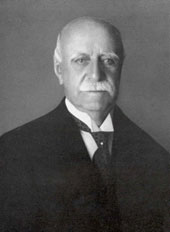 |
| Institution: | Disconto-Gesellschaft | |
| Functions: | Joint Proprietor 1895-1919 |
Schinckel came from an old-established Hamburg merchant family. His father, however, had spent several decades in Russia as a partner in the trading house "Blessig & Co.". It was only in the summer of 1849, shortly before Schinckel's birth, that the family returned to Hamburg.
After graduating from the Realschule des Johanneums, Schinckel completed a commercial apprenticeship from 1864 to 1867 at the Hamburg trading house Burmester & Stavenhagen, where he remained for another year as a "Commis" after his training. In 1868/69, he served as a one-year volunteer in the Prussian Dragoon Regiment No. 6 in Hadersleben/Northern Schleswig, which he completed as a reserve officer. In 1869, he took a position in the trading house of the businessman Moritz Ponfick, originally from Frankfurt am Main, in St. Petersburg, which he interrupted in 1870/71 due to his active participation in the Franco-Prussian War.
After initially returning to his old position in St. Petersburg in the summer of 1871, he commenced his activity as the third director of Norddeutsche Bank in Hamburg on November 12, 1872, at just 23 years old. This Hamburg stock bank, then the most significant alongside Vereinsbank, primarily focused on financing overseas business and had widespread business interests in South America. In 1878, Schinckel was promoted to second director as Siegmund Hinrichsen's successor, and from 1891, he was the bank's senior director.
Not least, his marriage to the daughter of the Hamburg grand merchant Gustav Berckemeyer granted Schinckel access to the economic elite of the Hanseatic city. He succeeded in binding the most prominent Hamburg shipping families, Laeisz and Woermann, who had previously worked with Vereinsbank and Commerz- und Disconto-Bank respectively, more closely to Norddeutsche Bank. Through his acquaintance with Emil Russell, Schinckel was able to persuade Disconto-Gesellschaft in Berlin to participate with Norddeutsche Bank in a series of South American ventures, such as the founding of the Brasilianische Bank für Deutschland, the Große Venezuela-Eisenbahngesellschaft, and the establishment of a "Konversionskasse zur Stabilisierung der argentinischen Währung" (conversion fund for stabilizing the Argentine currency).
As an expert in foreign business, he advised Adolph von Hansemann, the head of Disconto-Gesellschaft, on many occasions. In 1895, Norddeutsche Bank was finally acquired by Disconto-Gesellschaft and converted into a limited partnership with shares, with Norddeutsche Bank continuing to operate under its previous name. Schinckel became a business owner of both institutions but continued to operate from Hamburg. Until World War I, in addition to the traditional South American interests and strong involvement in the shipping industry, he primarily managed business in Hamburg.
In 1919, he retired from active banking but remained on the supervisory boards of Disconto-Gesellschaft and Norddeutsche Bank, serving as chairman until its merger with Deutsche Bank in 1929. Subsequently, he served as honorary president of the supervisory board of the merged institution until 1933.
Schinckel was considered the epitome of a banker with a Hanseatic character, combined in his case with great enthusiasm for Kaiser Wilhelm II. In 1917, Schinckel was elevated to the Prussian nobility. He deeply rejected the Weimar Republic and the social and cultural changes of the 1920s: "Times have simply changed, but Herr von Schinckel has not." (Frankfurter Zeitung 1929) Among the business owners of Disconto-Gesellschaft, he was counted among the most conservative. Politically, he was involved with the "Stahlhelm".
He served as Chairman of the Supervisory Board, among others, for the following companies: Bank für Chile und Deutschland, Brasilianische Bank für Deutschland, Dynamit AG, Hapag, Hamburg-Südamerikanische Dampfschiffahrts-Gesellschaft, and Norddeutsche Affinerie. In 1907, he became President of the Hamburg Chamber of Commerce. He was a member of the board of the Central Association of German Banks and Bankers, chairman of the synod of the Evangelical Church, and president of the Hamburg Racing Club (equestrian sport).
Show content of Schlieper, Gustaf
| Biographical data: | 28.02.1880 in Berlin - 24.08.1937 in Bühlerhöhe |  |
| Institution: | Disconto-Gesellschaft / Deutsche Bank | |
| Functions: | Joint Proprietor / Member of the Management Board 1914-1937 |
Schlieper came from an Elberfeld banking family. His father, Eugen Schlieper, ran his own banking house in Berlin. After an apprenticeship at the banking house Georg Fromberg & Co, he went to Amsterdam, London, and New York for further training. He then undertook study trips to Mexico and the USA.
In 1902, he joined the Berlin headquarters of Disconto-Gesellschaft, where he initially worked primarily in the executive office. In 1905, he was granted power of attorney. During this time, he was involved in the founding of Kreditbank in Sofia, of which he later became Chairman of the Supervisory Board. From 1908, he was Director of the Frankfurt branch of Disconto-Gesellschaft until he was appointed partner of Disconto-Gesellschaft in 1914.
After the merger with Deutsche Bank, he remained a member of the Management Board of the combined institution until his death. His scope of work expanded considerably when, after the 1929 merger, the overall management of Deutsche Bank's entire foreign business passed into his hands. Here, the cosmopolitan Schlieper, who had acquired his banking expertise primarily abroad, was able to fully develop his skills. He coined the term "commercial idealism," which a banker active in foreign trade particularly needed to possess.
He found a valuable platform for his work in Deutsche Ueberseeische Bank (DUB), which consolidated the bank's Spanish and South American interests. From 1933 until his death, he was Chairman of the Supervisory Board of DUB.
Schlieper became known to a wider public through the standstill negotiations following the banking crisis of 1931, when foreign banks attempted to abruptly withdraw their short-term loans to Germany. Schlieper led the German delegation both in Basel, where the first standstill agreement covering more than six billion Reichsmarks of German foreign loans was concluded in August 1931, and at subsequent standstill conferences.
Furthermore, he made himself available for general tasks in the credit industry in a number of important foreign trade bodies and on the advisory board of Deutsche Golddiskontbank. Schlieper's outstanding achievements for Disconto-Gesellschaft's foreign business, which he brought into the merged institution from 1929, largely contributed to restoring international relations that had been severely affected after the First World War. Schlieper's successor in foreign business and on the Standstill Commission from 1938 was Hermann J. Abs, who had newly been appointed to the Management Board.
Show content of Schlitter, Oscar
| Biographical data: | 10.01.1868 in Lennep - 30.11.1939 in Berlin | 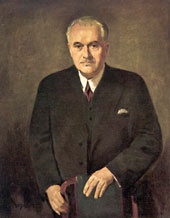 |
| Institution: | Deutsche Bank | |
| Functions: | Member of the Management Board 1912-1932, Chairman of the Supervisory Board 1933-1939 |
Schlitter's paternal ancestors came from Schlitters in the Zillertal (Tyrol), but arrived in central Germany as Protestant religious refugees. Schlitter's father served as a soldier and later ran a post office in Lennep near Remscheid. After the start of railway operations, he became a railway postal conductor. In 1869, the family moved to Düsseldorf. Oscar Schlitter spent his school years there and subsequently completed a commercial apprenticeship.
In 1887, he joined the "Bergisch Märkische Bank", initially as a correspondent, later in the securities department. In 1894, he moved to "Essener Credit-Anstalt", which, as the leading industrial bank in the Ruhr region, offered him a broader scope of work. Already in 1901, he was appointed to its Management Board there. In 1906, through the mediation of Carl Klönne, he joined the Management Board of "Deutsche Bank" as a deputy member. However, in 1908, he returned to "Bergisch Märkische Bank" for four years, which by then was already closely associated with "Deutsche Bank".
Due to his excellent knowledge of West German industry, he was considered particularly suitable to lead the industrial financing business of "Bergisch Märkische Bank". It was not until 1912 that Schlitter returned to the Management Board of "Deutsche Bank" in Berlin, where he prepared the merger of "Bergisch Märkische Bank" with "Deutsche Bank" (1914). This was the largest merger in German stock corporation history up to that point and simultaneously the prelude to further bank consolidations that expanded the branch networks of the major banks and led to a real presence across the country for the first time.
In the following years, Schlitter was significantly involved in the further development of industrial concentration in West Germany, for example, in creating the financial prerequisites for the founding of "Vereinigte Stahlwerke" and the reorganization of the Stumm Group. Schlitter's activity as an industrial banker was not limited to the mining and steel industry. The expansion of the bank's industrial business meant that Schlitter also took on mandates for companies in potash mining, mechanical engineering, and the electrical industry, including the chairmanship of the supervisory boards at Deutsche Kaliwerke, Demag, and Mannesmann. His commitment also extended to the insurance industry. Within the "Nordstern" insurance group, the transfer of "Vaterländische" and "Rhenania" to "Nordstern" (1929) was particularly significant as a transaction; a measure which, after the collapse of Frankfurter Versicherungs-AG, significantly contributed to restoring confidence in the German insurance industry.
After the merger of "Deutsche Bank" with "Disconto-Gesellschaft", Schlitter remained on the Management Board of the combined institution for another three years, before moving to the Supervisory Board in mid-1932, which he chaired from 1933 to 1939 – alternating annually with Franz Urbig. After the death of Eduard Mosler in August 1939, there were considerations to reactivate Schlitter as a member of the Management Board. Due to his age, but also against the backdrop of the political circumstances, he did not want to take on this responsibility again.
"Schlitter - that is a man who has no enemies" was the dictum rarely expressed about a leading personality in the banking industry. It referred to a Management Board member who, through his close contacts with the West German industrial region – succeeding Carl Klönne – helped Deutsche Bank open up this central economic region. Schlitter pursued his inclination for scholarly discourse as a member of the Berlin "Mittwochsgesellschaft" since 1932.
Show content of Schmitz, Ronaldo H.
| Biographical data: | 1938 |
| Institution: | Deutsche Bank |
| Functions: | Member of the Management Board 1991-2000 |
Show content of Schneider-Lenné, Ellen Ruth
| Biographical data: | 28.05.1942 in Berlin - 25.12.1996 in Königstein | 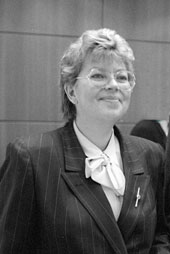 |
| Institution: | Deutsche Bank | |
| Functions: | Member of the Management Board 1988-1996 |
After completing her studies in business administration, Schneider-Lenné began her career at Deutsche Bank in 1967 as a loan officer at the Hamm branch. In 1971, she gained her first experience abroad as a Deutsche Bank delegate at the European American & Trust Co. in New York. In 1973, Franz Heinrich Ulrich, then Spokesman of the Management Board, brought her to the head office as his assistant. In 1975, a second stay abroad followed in London. She was part of the "Team London" that prepared the transformation of the London representative office into a branch in 1975/76 (as Deutsche Bank's first foreign branch after the Second World War). She returned to Germany in 1980 and in 1985 - by then a specialist in foreign trade finance - she became head of the International Trade Finance Department in the management of the Central International Department.
In 1988, Schneider-Lenné was appointed to the Management Board of Deutsche Bank, where she remained until her death. Here she headed the Credit Risk Management and Financial Institutions departments. She was responsible for international business in the United Kingdom and Ireland, and for domestic business in the Wuppertal region. Schneider-Lenné was Chairwoman of the Supervisory Board of AKA Ausfuhrkreditgesellschaft and was in charge of mandates at Industriebank von Japan AG and Readymix AG for participations, among others.
Ellen Ruth Schneider-Lenné, who had exceptional negotiating skills, was the first woman to serve on the board of a major German bank.
Show content of Schoeller, Alexander
| Biographical data: | 24.03.1852 in Elberfeld - 22.11.1911 in Berlin | 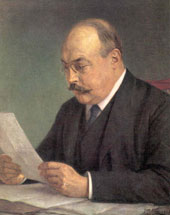 |
| Institution: | Disconto-Gesellschaft | |
| Functions: | Member of the Management Board 1884-1911 |
Alexander Schoeller was one of the few executives who, prior to the merger, successively held senior positions at both Deutsche Bank and Disconto-Gesellschaft.
Schoeller came from an industrialist family in the Rhineland-Westphalia region. After an apprenticeship at the Elberfeld banking house Arthur Blanck, he volunteered for the Franco-Prussian War. This was followed by further years of training in Brussels and London.
In the mid-1870s, he traveled to Montevideo on behalf of Deutsche Bank, presumably in connection with the Deutsch-Belgische La Plata Bank, in which Deutsche Bank had acquired a stake in 1874. Upon his return to Germany, he was appointed deputy director of the Deutsche Bank Hamburg branch in 1877, but he left this position in 1880 when he was appointed to the management of the Preußische Seehandlung. By 1881, he already held the title of Geheimer Seehandlungsrat (Privy Councillor of the Maritime Trading Company). At the Preußische Seehandlung, he was primarily responsible for syndicate business.
His excellent knowledge of banking and capital market conditions led Adolph von Hansemann to notice him, and in 1884, Hansemann recruited Schoeller for the position of the fifth managing partner of Disconto-Gesellschaft, which had become vacant due to Emil Hecker's departure. Here, he initially worked in the executive office, which consolidated the management of the bank's ongoing business.
After the death of Adolph von Hansemann and the departure of Emil Russell and Alfred Lent from the management board, he took over the so-called "Chefkabinett" (executive cabinet) of Disconto-Gesellschaft in 1903 as the senior managing partner. This cabinet was responsible for general business organization, participations, issuance business, and the cultivation of important business relationships outside of day-to-day banking operations. Here, he also continued Hansemann's involvement in colonial territories, for example, in the Neu-Guinea-Gesellschaft, the Schantung-Eisenbahn, or as chairman of the supervisory board of Otavi Minen AG. He also held other important mandates on the supervisory boards of Banca Commerciale Italiana, Preußische Central-Bodenkredit AG, and RWE.
Show content of Schröter, Gustav
| Biographical data: | 11.07.1852 in Berlin - 18.11.1931 in Berlin | 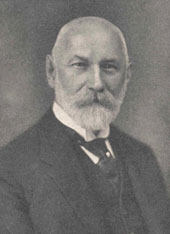 |
| Institution: | Deutsche Bank | |
| Functions: | Member of the Management Board 1906-1925 |
After completing his commercial apprenticeship at a Berlin iron and metal goods factory, Schröter joined the Berliner Bankverein in 1870, which was acquired by Deutsche Bank in 1875 as one of its first banking houses. When Deutsche Bank moved to the Behren-/Mauerstraße district in 1876, deposit transactions had already grown to such an extent that the cashier's office remained at its previous location in Burgstraße as an independent city branch – the first deposit office. Gustav Schröter became its head. In 1881, he was granted power of attorney, in 1900 he was appointed deputy director, and in 1906 he was appointed to the Management Board.
During his half-century of activity for Deutsche Bank, Schröter was almost exclusively responsible for the deposit business, which earned him the nickname "Father of the Deposit Offices"; at Deutsche Bank's headquarters in Berlin alone, over sixty city branches were established over time. Under his care, their tasks were adapted to the changing conditions in the deposit business. Eventually, a deposit office could offer almost the same services as the head office (with the exception of syndicate and overseas business). A particular concern for Schröter was the thorough training of the heads of the deposit offices (branch managers).
His experience in the deposit business made Schröter a strong advocate for cashless payment and cheque transactions. With his area of responsibility, Schröter was considered a pronounced internal worker, who, as a personality, hardly appeared outside Deutsche Bank.
Show content of Seeling, Otto
| Biographical data: | 01.03.1891 in Fürth - 28.02.1955 in Fürth | 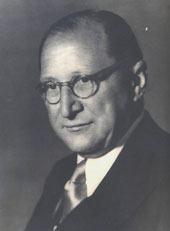 |
| Institution: | Süddeutsche Bank AG | |
| Functions: | Chairman of the Supervisory Board 1952-1955 |
Otto Seeling grew up as the son of a master craftsman in modest circumstances. After completing secondary school (1908), he completed a commercial apprenticeship and was employed in commercial positions from 1910-1913. He used these years for self-study; he passed his Abitur (university entrance examination) and studied political science and business administration in Erlangen and Frankfurt am Main. In 1917, he passed his diploma examination at the University of Frankfurt. Subsequently, he became a research assistant at the Nuremberg Chamber of Commerce and received his doctorate in 1918 with a thesis on industrial bonds. This drew attention to him in business circles. He was initially a trustee for the foreign trade offices of the leather industry, the glass industry, and the German book trade. In 1923, he became a board member of Tafel-Salin-und Spiegelglasfabriken AG in Fürth (since 1932 Deutsche Tafelglas AG) and finally, in 1926, chairman of the board of this company. Thus, he had achieved a leading position in the South German economy, which he maintained until his death, and which also brought him to the forefront of the emerging larger interest groups of the German flat glass industry, some of which originated from his initiative. Since 1934, he had a close relationship with Deutsche Bank; first as a member of the Bavarian Advisory Board, a position he held until 1945, and from 1952-1955 as Chairman of the Supervisory Board of Süddeutsche Bank AG, in Munich. The contact with Deutsche Bank came about, among others, through Hans Rummel (member of the Bank's Management Board from 1933-1945), who in turn served as Chairman of the Supervisory Board of Deutsche Tafelglas AG since 1938.
Show content of Sewing, Christian
| Biographical data: | 1970 |
| Institution: | Deutsche Bank |
| Functions: | Member of the Management Board since 2015, President of the Management Board 2017-18, Chief Executive Officer of the Management Board since April 2018 |
Show content of Short, Rebecca
| Biographical data: | 1974 |
| Institution: | Deutsche Bank |
| Functions: | Member of the Management Board since 1 May 2021 |
Show content of Siemens, Georg von
| Biographical data: | 21.10.1839 in Torgau - 23.10.1901 in Berlin | 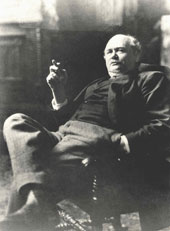 |
| Institution: | Deutsche Bank | |
| Functions: | Member of the Management Board 1870-1900 (Spokesman 1870-1900) |
Georg von Siemens was the central figure in the founding of Deutsche Bank. He decisively influenced its history over three decades. The son of a lawyer and official in the Prussian civil service, he completed his schooling at the "French Gymnasium" in Berlin and then studied law in Heidelberg. Following civil service examinations and military service in the Austro-Prussian War, he joined the company Siemens & Halske. His relationship with Werner von Siemens, the founder of the electric company and his father's cousin, was very close with the result that Werner von Siemens entrusted the young man with leading the negotiations in 1868/69 in London and Tehran for him on the construction of the Indo-European telegraph lines. It was here that Adalbert Delbrück, head of the traditional private bank Delbrück Leo & Co. in Berlin, took note of Georg von Siemens because of his great skill in negotiations. At that time, Delbrück was engaged, together with the national-liberal politician and monetary expert Ludwig Bamberger, in founding a bank for foreign trade and was looking for a director. Delbrück proposed Siemens although he was entirely without experience until then in banking for the direction of Deutsche Bank, newly founded in 1870. And thus an experienced banking expert, Hermann Wallich, was appointed to work alongside Siemens. Siemens quickly realized that Deutsche Bank would only be able to achieve its goals, of facilitating and expanding the transaction of trade and payments abroad if it could draw upon a broad-based domestic banking business. Siemens created this basis starting in 1877 by initiating the deposit-taking business, which only the "Sparkassen" (public-sector savings banks) had systematically applied themselves to until that time, and thus Deutsche Bank secured a big lead for itself. This set an example the entire German banking industry was to follow. Siemens also advanced the deposit-taking business through his work on developing cheque payments. With its basis in domestic business, the bank was in a position to execute its original programme of foreign trade financing and was even able to set up branches in 1873 in London as well as found Deutsche Ueberseeische Bank in 1886 and Deutsch-Asiatische Bank in 1889. The success Deutsche Bank achieved in its domestic banking business under the direction of Georg von Siemens meant that already during the last quarter of the 19th century a number of branches had been set up in Germany (Bremen, Hamburg, Frankfurt and Munich), and close relationships had been established with other banks. Shareholdings were acquired in Württembergische Vereinsbank, Schlesischer Bankverein and Bergisch-Märkische Bank. In this manner, a banking group was created with which Siemens could also propose larger financing projects. Especially noteworthy among these was the involvement in creating the German electrical industry. In 1887 Deutsche Bank, together with Delbrück Leo & Co., underwrote the largest portion of the capital increase of Deutsche Edison-Gesellschaft, which was simultaneously renamed Allgemeine Elektricitäts-Gesellschaft (AEG). Siemens was a member of the supervisory board of AEG for seven years. He also provided his experience to the undertakings of Siemens & Halske AG. Deutsche Bank was concurrently involved in a number of important electricity plants and tramway companies. Siemens also played a decisive role in working on the establishment of Berlin's tram and underground. Together with Max Steinthal, he was involved in the establishment of Mannesmannröhren-Werke (pipe mills). The relationships Georg von Siemens established for the newly founded Deutsche Bank in Germany soon led to more business abroad. The Bank für elektrische Unternehmungen, founded in Zürich at his initiation, managed the interests of German banks in international business. Georg von Siemens' activities in foreign undertakings reached its zenith with Deutsche Bank's participation in the financing of North American railways, in particular the Northern Pacific Railway Company. When this company collapsed in 1893 following misguided speculative activities, Siemens established a reorganization committee in New York for the owners of the railway bonds. Furthermore, Siemens initiated a company in Germany for the protection and promotion of German investments in the USA. It was founded in March 1890 and called the Deutsch-Amerikanische Treuhand-Gesellschaft (starting in 1892, Deutsche Treuhand-Gesellschaft). Again and again, Siemens was involved in large-scale financing transactions that were to solidify the international reputation of Deutsche Bank, for example, by underwriting bonds for the city of Bucharest and the Principality of Bulgaria and by participating in the establishment of Banca Commerciale Italiana (1894). The foundation of the Anatolian Railway Company, brought about by Siemens in 1889, marked the beginning of Deutsche Bank's interests in the Orient and the Baghdad Railway, even if Siemens was very sceptical of this large-scale project for quite some time. For his services in Turkey, Siemens was accorded a heritable title of nobility in 1899. But Siemens' activities were not limited to his work for Deutsche Bank. For numerous years, he was a dedicated member of, among other organizations, the Association of German Banks, the Committee of the German Trade Board, and the Association of Berlin Merchants and Industrialists. As a member of the Committee of the German Trade Board, he worked on the German law on cheques. As a member of the German Parliament, in which he was first a member of the national-liberal party and later the liberal-minded party, he expressed his views especially on issues concerning banking, the law on minting, the stock exchange tax, and in favour of the renewal of trade agreements. Slogans praising the patriotism holding sway during the period were strange to Siemens. He regarded Deutsche Bank as an institution with international operations not just with regard to the territorial expansion of its business, but also because of its cosmopolitan spirit. "When he joined Deutsche Bank in 1870, Siemens was from a totally different field, but he had a great deal of self-confidence and expansive plans, equipped with a great deal of energy. Furthermore, he was not a banker in the traditional sense, that is a private bankier liable with his own personal capital, but rather a simple employee - as one said at that time, a bank manager, that is a completely new type of banker, and as such he brought into this cultivated and tasteful world of private bankiers, who had founded the bank in the spring of 1870, an entirely new tone - in his speech as well - casual but also aggressive, and at the same time ironic and self-ironic". (Lothar Gall). At the end of his period of office thirty years later in 1900, Deutsche Bank was the largest bank in Germany, and on its way to becoming the largest in the world. Deutsche Bank had surpassed not only all of the private banks, but also the previously undisputed No. 1 among the stock corporation banks, Disconto-Gesellschaft, founded in 1851 by David Hansemann, as well as the competing credit institutions founded in 1870 and 1872, Commerzbank and Dresdner Bank.
more information:
Brought to Light - Documents pertaining to the history of Deutsche Bank [1] [2] [3]
Milestones - Stories pertaining to the history of Deutsche Bank [1]
Show content of Simon, Stefan
| Biographical data: | 1969 |
| Institution: | Deutsche Bank |
| Functions: | Member of the Management Board from 1 August 2020 - 30 April 2025 |
Show content of Sippell, Karl Ernst
| Biographical data: | 04.02.1889 in Bad Sooden-Allendorf - 02.05.1945 in Berlin | 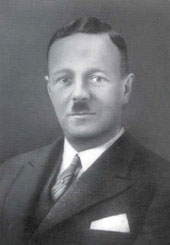 |
| Institution: | Deutsche Bank | |
| Functions: | Member of the Management Board 1933-1945 |
Sippell came from a family of pastors and doctors. After completing his law studies and doctorate, Sippell joined the Chefkabinett of Disconto-Gesellschaft in 1918. The Chefkabinett was the special office of the institution, where all threads of major financial and industrial business converged, and where all technical work related to the execution of issuance and syndicate business was handled. For a young banker, it was the high school of 'banque d'affaires', which, with its extensive connections in domestic and international business, offered opportunities for comprehensive training.
Within this framework, Sippell acquired profound knowledge and experience, which, combined with his business acumen, led to his appointment as deputy member of the Management Board of Deutsche Bank und Disconto-Gesellschaft after the 1929 merger. After a year of managing the Frankfurt am Main branch, Sippell returned to Berlin in 1933 as a member of the Management Board. Geographically, he was responsible for Southern Germany.
His important supervisory board mandates, which he took over primarily from Theodor Frank, who had been forced out of the Management Board in 1933, included the chairmanship of Heinrich Lanz AG in Mannheim and Zellstofffabrik Waldhof, as well as the deputy chairmanship of Deutsch-Asiatische Bank and Süddeutsche Zucker AG. Furthermore, after 1933, he was temporarily responsible for human resources, a position he gladly relinquished to Karl Ritter von Halt in 1938 due to numerous internal disputes with party members.
At the outbreak of the war, Sippell was called up for military service. Only after the unexpected death of Johannes Kiehl in mid-1944 was it possible to secure Sippell's final discharge from the Wehrmacht. Having returned to the bank, he was responsible, among other things, for leading the Legal Department during the final months of the war.
Sippell died a violent death during the Battle of Berlin. While attempting to get from his private residence in Grunewald to Deutsche Bank's headquarters on Mauerstrasse, he was shot by Russian soldiers on May 2, 1945.
Show content of Solmssen, Georg
| Biographical data: | 07.08.1869 in Berlin - 10.01.1957 in Lugano | 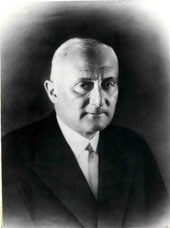 |
| Institution: | Disconto-Gesellschaft / Deutsche Bank | |
| Functions: | Joint Proprietor / Member of the Management Board 1911-1934 (Spokesman 1933) |
Born as Georg Salomonsohn, Georg Solmssen, the son of the former proprietor of Disconto-Gesellschaft Adolph Salomonsohn, studied law and earned his doctorate with a dissertation on trade workers' law. In 1900 he left the civil service as a court assessor and joined Disconto-Gesellschaft. Solmssen quickly made a career for himself: in 1904 he was already director, and by 1911 he was accepted into the body of proprietors, the Chief Cabinet. At Disconto-Gesellschaft, Solmssen worked primarily on large industrial and consortial business and maintained, in particular, relationships with the West German mining industry.
Solmssen reorganized the A. Schaaffhausen'sche Bankverein in Cologne and prepared the step-by-step integration of this important Rhineland industrial bank into the Disconto-Gesellschaft corporate group. Following the merger in 1914, he worked for a number of years as a member of the management board of the Cologne credit institution. He had a predilection for new economic branches, whose expansion fascinated him. Thus, he handled the bank's petroleum interests in Romania and dedicated himself to the transactions of Deutsche Erdöl AG in Berlin.
After the First World War, Solmssen frequently visited the USA to conduct business. He concluded various contracts with foreign telegraph companies for the reconnection of Germany to the international cable network for Deutsch-Atlantische Telegraphen-Gesellschaft, whose supervisory board he was the chairman of.
Despite Solmssen's workload at the bank and his numerous supervisory board mandates with leading companies of the German economy, the energetic and cosmopolitan banker was actively involved in issues of public life. For example, Solmssen was elected chairman of the Central Association of German Banks and Bankers in December 1930 and was able to represent the interests of the credit economy to the public until 1933. He was also very active in publishing works: his writings, lectures and speeches were published in 1934 as a two-volume work entitled "Contributions to German Politics and the Economy 1900-1933" and are important eyewitness reports of this period in economic history.
Solmssen spoke out on politics and the economy, for example in 1931 at a conference of the Central Association of German Banks and Bankers in Berlin: "Politics and the economy are heterogeneous activities that must supplement each other, but must never be the same. If politics or the economy leave the areas assigned to them according to their nature and if they get into each other's way, then only disaster will come of it. The economy must not engage in politics, nor politics in the economy."
After the merger of Deutsche Bank and Disconto-Gesellschaft in October 1929, Georg Solmssen became member of the Board of Managing Directors of the merged credit institution. Solmssen had already converted to Christianity at the turn of the century and had "Germanicized" the Jewish name Salomonsohn, considering he saw a future for himself only in complete assimilation. When the National Socialists came into power, Solmssen's activities were nonetheless at an end. In a moving letter to the Chairman of the Supervisory Board Franz Urbig on April 1933, Solmssen expressed himself prophetically on the coming fate of the economic elite with Jewish origins: "I fear we are only at the beginning of a conscious and planned development which is aimed at the indiscriminate economic and moral destruction of all members of the Jewish race living in Germany." Although he was still the bank's Spokesman at its general meeting in 1933, he was forced to leave the Board of Managing Directors of the bank in 1934 and was then a member of the Supervisory Board until the general meeting 1938. Afterwards, he emigrated to Switzerland.
Show content of Stauß, Emil Georg von
| Biographical data: | 06.10.1877 in Friedrichsthal - 12.12.1942 in Berlin | 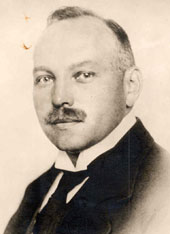 |
| Institution: | Deutsche Bank | |
| Functions: | Member of the Management Board 1915-1932 |
The son of a teacher, he began his career in 1893 at the Royal Württemberg Court Bank in Stuttgart. In 1898, Stauß joined Deutsche Bank, where he worked in securities administration, in the so-called "dead depot," at the Berlin headquarters. In addition, he had passed an examination as a shorthand teacher. Thus, he was chosen when Georg von Siemens was looking for a new secretary. This marked the beginning of Stauß's career. After Siemens' death, he worked in the bank's secretariat under Arthur von Gwinner. Here, he managed the establishment of the European Petroleum Union, into which Deutsche Bank contributed the share capital of the Romanian Steaua Romana, and temporarily took over its management. Even after he joined the Management Board of Deutsche Bank in 1915, following Karl Helfferich's departure, the petroleum business remained one of his main areas of activity until the end of the First World War. Furthermore, the seasoned expert on the Balkans and the Orient was responsible during the First World War for the administration of the Anatolian Railway Company, initiated by Deutsche Bank, and dedicated himself to the further construction of the Baghdad Railway. Ennobled in the last year of the war, after 1918 he focused primarily on the aviation and automotive industries. Stauß was not only Chairman of the Supervisory Board of Daimler-Benz but also of BMW since 1925. In this capacity, he not only monitored the development of corporate finances but also dealt with issues of product range, quality control, and marketing. Stauß also held another important Supervisory Board chairmanship for Vereinigte Glanzstoff-Fabriken. Stauß's involvement in the founding of Germany's most important film company, Ufa, established in 1917 with the help of private and state capital, of which he was also Chairman of the Supervisory Board for many years, is particularly remembered. The scandal surrounding the Berlin Schultheiß brewery, where Stauß, as Deputy Chairman of the Supervisory Board, did not react appropriately, led to his resignation from the Management Board in 1932 (a number of banks had made lively speculative purchases in Schultheiß, although Deutsche Bank and Disconto-Gesellschaft were actually the issuing banks for the company). However, he remained a member of Deutsche Bank's Supervisory Board until his death. Although he was no longer involved in the bank's day-to-day business after 1932, Stauß retained an office at the headquarters and continued to look after the bank's interests. Stauß was considered a distinctly political banker. Shaped by the extensive experience he had gained during the German Empire and the Weimar Republic, he saw his political involvement primarily as the task of building connections to the government, regardless of the form that government took. He was a member of the German People's Party, for which he was elected to the Reichstag in 1930. His political activity continued under National Socialism, without him ever joining the NSDAP. In 1933, he was appointed to the Prussian State Council by Hermann Göring, with whom he maintained a personal friendship. From 1934, he was Vice President of the Reichstag. "In the unfavorable economic climate of the interwar period, making the 'rising stars' – the film industry, the automotive industry, aviation – shine was no easy task, and however short-sighted Stauß may have been in his political judgment, much good can be said about the way he tried to advance the companies entrusted to him. The history of relations between Deutsche Bank and the automotive industry in the interwar period is, in large part, his story." (Gerald D. Feldman)
Show content of Steinmüller, Werner
| Biographical data: | 1954 |
| Institution: | Deutsche Bank |
| Functions: | Member of the Management Board August 2016 - July 2020 |
Show content of Steinthal, Max
| Biographical data: | 24.12.1850 in Berlin - 08.12.1940 in Berlin | 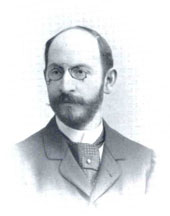 |
| Institution: | Deutsche Bank | |
| Functions: | Member of the Management Board 1873-1905, Chairman of the Supervisory Board 1923-1932 |
Alongside Georg von Siemens and Hermann Wallich, Max Steinthal was one of the leading figures in the early days of Deutsche Bank. Steinthal came to Deutsche Bank through his travel acquaintance with Deutsche Bank's Management Board member Hermann Wallich. who recommended him to his colleague Georg von Siemens. When Siemens invited the young man for a talk at Deutsche Bank, he asked him: "So you want to become an attorney at Deutsche Bank?" "No," Steinthal then explained, "not an attorney, but a director." On 13 December 1873, Max Steinthal became a member of the Management Board of Deutsche Bank, alongside Georg von Siemens and Hermann Wallich. Through Steinthal's activities, Deutsche Bank was soon in a position to gain a good position in the international foreign exchange business. Until 1876, the government's silver purchases were brokered exclusively by Deutsche Bank. At that time, however, Steinthal also took care of the domestic current account and financing business. At the same time, he organised Deutsche Bank's stock exchange business. One of Steinthal's most important works was the conversion of the plants owned by the Mannesmann family in Remscheid, Bous and Komotau into the joint stock company Deutsch-Österreichische Mannesmann-Röhrenwerke AG and the subsequent reorganisation of the company. The outstanding services he had rendered to German banking over sixty years no longer applied under National Socialism. In May 1935, he resigned from the Supervisory Board of Deutsche Bank in order, as he put it, not to cause the bank any difficulties. Steinthal, who had never left his hometown of Berlin for more than a few weeks throughout his life, could not decide to emigrate despite rapidly deteriorating living conditions. Steinthal died two weeks before his 90th birthday in a Berlin hotel room, after he had been forced to sell his estate in Charlottenburg the year before. In 2004, an exhibition dedicated to the banker and art collector Max Steinthal took place at the Jewish Museum Berlin.
Show content of Strauß, Frank
| Biographical data: | 03.02.1970 in Heide - 23.05.2024 |  |
| Institution: | Postbank, Deutsche Bank | |
| Functions: |
CEO Postbank 2012-2018 |
Strauss spent a large part of his professional life at Deutsche Bank. After completing his training as a bank clerk in Iserlohn, he came to Frankfurt in 1995, where he worked in various management positions at Deutsche Bank and its former subsidiary Deutsche Bank 24. From 2002, he coordinated Deutsche Bank's retail banking in Europe, and from 2005 in India and China. In 2006, he took over the management of the private and business customer division in the German home market. In 2011, he then moved to Postbank as its Management Board member responsible for sales and, a year later, he became CEO. From 2017 to 2019, he was a member of the Deutsche Bank Management Board and oversaw private and corporate banking, initially together with Sewing and, after the latter’s appointment as CEO, from April 2018 alone.
Parallel to his professional career, Strauss pursued an athletic career as an ice hockey professional until the end of the 1990s.
Show content of Sulzbach, Rudolf
| Biographical data: | 09.04.1827 Frankfurt am Main - 23.01.1904 Frankfurt am Main |
| Institution: | Deutsche Bank |
| Functions: | Member of the Administrative Board 1870-1904 |
The banker Rudolf (Ruben until 1864) Sulzbach, as a representative of his banking house Gebr. Sulzbach, which represented the interests of several Frankfurt shareholders, acquired shares worth 799,000 talers, the largest single amount of all participations. He was a member of Deutsche Bank's Supervisory Board from the first General Meeting until his death.
In 1856, Rudolf Sulzbach founded the banking house S. Sulzbach in Frankfurt am Main with his older brother Siegmund, which was renamed Gebr. Sulzbach in 1866. The siblings were related to the Rothschild family on their mother's side and themselves rose to become one of the most successful Jewish banking houses of their time. In stock exchange business, Sulzbach focused on trading railway shares and government bonds; for example, after the American Civil War, he brokered United States Bonds through a temporary participation in New York starting in 1865. Sulzbach paid great attention to promoting new technologies. Together with the Berlin banker Jacob Landau and the Nationalbank für Deutschland, he formed a consortium that acquired the Edison license rights for the light bulb, and financed a study company that was to prepare the dissemination of this invention in Germany.
After the founding of Deutsche Bank, close cooperation with the banking house Gebr. Sulzbach was established. For example, Deutsche Bank's first participation in London in the German Bank of London, founded for this purpose in 1871, was only made possible by Gebr. Sulzbach. Close cooperation between both banks also took place during the founding of the Deutsche Edison-Gesellschaft für angewandte Elektrizität (later AEG) in 1883.
From 1872, Sulzbach was a member of the Frankfurt Chamber of Commerce, of which he became an honorary member before his death. In 1892/93, he served as an expert for the Stock Exchange Inquiry Commission in the Reichstag.
Show content of Thierbach, Hans-Otto
| Biographical data: | 30.04.1923 in Leipzig - 15.05.2012 in Kronberg | 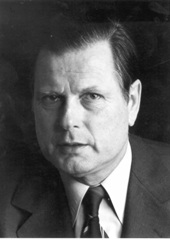 |
| Institution: | Deutsche Bank | |
| Functions: | Member of the Management Board 1971-1980 |
The son of a Deutsche Bank director began a banking apprenticeship at Deutsche Bank in Fürth in 1946, which he completed in Hamburg in 1948. In the following years, he was employed at the headquarters of Rheinisch-Westfälische Bank in Düsseldorf, one of Deutsche Bank's successor institutions, interrupted by a stay abroad in Great Britain (1949) and an internship at New York banks (1951). Subsequently, he pursued a career in Deutsche Bank's branch network: authorized signatory in the Essen branch in 1953, branch manager in Gelsenkirchen in 1955, deputy director in Oberhausen in 1956, and in Essen in 1957. From 1960, Thierbach dedicated himself to expanding international business at Deutsche Bank's Düsseldorf headquarters. In 1961, he was appointed director, and in 1967, Senior Group Director. When the entire bank's international business was centralized in Frankfurt in 1969, he moved to the headquarters there. In 1971, he was appointed deputy member, and in 1973, full member of Deutsche Bank's Management Board, to which he belonged until 1980. International business also remained his main focus of work on the Management Board. In addition, Thierbach was responsible for the foreign exchange and precious metals business, as well as the management of the main branch district of Hanover. His important Supervisory Board mandates included the Euro-Pacific Finance Corporation in Melbourne, Banque Européenne de Crédit à Moyen Terme in Brussels, and Compagnie Financière de la Deutsche Bank AG in Luxembourg.
Show content of Tron, Walter
| Biographical data: | 29.04.1899 in Pforzheim - 14.12.1962 in Munich | 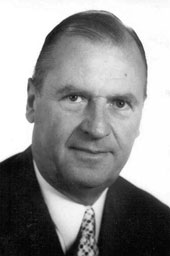 |
| Institution: | Deutsche Bank | |
| Functions: | Member of the Management Board Süddeutsche Bank 1952-1957 and Deutsche Bank 1957-1962 |
Among Walter Tron's ancestors were French religious refugees who, in the early 18th century, were among the founders of the Waldensian settlement of Palmbach near Karlsruhe. Following his military service in World War I, Tron began an apprenticeship in 1919 at "Süddeutsche Disconto-Gesellschaft" in his hometown of Pforzheim. Concurrently, he studied political science and law in Heidelberg, Freiburg, and Gießen. After completing his studies with a doctorate, he resumed his work at Süddeutsche Disconto-Gesellschaft in 1923, which merged in 1929 into "Deutsche Bank und Disconto-Gesellschaft" (renamed "Deutsche Bank" in 1937). In 1932, he was appointed senior official, and a year later he received power of attorney. After a brief period in Mannheim, Tron became deputy director in 1936 and director of the Pforzheim branch the following year. Still in 1937, he was appointed to the management of the significantly larger Mannheim branch. From there, he moved as director in 1939 to the Leipzig branch, one of Deutsche Bank's most important offices.
When Deutsche Bank acquired a majority stake in "Creditanstalt-Bankverein" in Vienna in spring 1942, Tron was appointed to the management board of Creditanstalt-Bankverein there, at the suggestion of Deutsche Bank board member Hermann J. Abs, and remained a board member until the end of the war. This assignment was considered a delicate mission and required a high degree of negotiating skill. As the sole representative from the "Altreich" (Old Reich) and of the main shareholder Deutsche Bank, Tron's actions were viewed with great skepticism by his Viennese colleagues.
In the years after 1945, Tron had to reorient himself, as his membership in the NSDAP (from 1937) initially prevented his immediate re-employment at Deutsche Bank. At the end of 1948, again at the initiative of Hermann J. Abs, he was appointed to the management board of the newly founded "Kreditanstalt für Wiederaufbau" (Reconstruction Credit Institute). He played a significant role in establishing this financial instrument for the West German economy, which was equipped with Marshall Plan funds. In April 1951, Tron returned to the Deutsche Bank Group by joining the management of "Bayerische Creditbank," the successor institution of Deutsche Bank in Bavaria (from September 1952 "Süddeutsche Bank"). After the re-establishment of Deutsche Bank AG in May 1957, he served on its Management Board until his death. There, he was responsible for Human Resources, Organization, and Audit, and his regional responsibility within Deutsche Bank extended to the branch districts of Munich and Mannheim.
Although Tron had a low public profile, his influence on the South German economy and, above all, on the development of Bavaria as an economic hub in the 1950s and early 1960s was considerable. This stemmed not least from his diverse activities as chairman of the supervisory boards of companies in the textile industry, Bavarian power plants, the glass and porcelain industry, as well as the transport and machinery industries.
Show content of Ulrich, Franz Heinrich
| Biographical data: | 06.07.1910 in Hanover - 16.03.1987 in Düsseldorf | 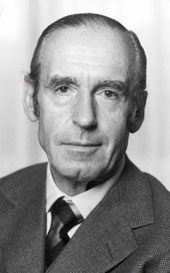 |
| Institution: | Deutsche Bank | |
| Functions: | Member of the Management Board 1957-1976 (Sprokesman 1967-1976) and Chairman of the Supervisory Board 1976-1984 |
The son of the Managing Director of the Bremen Chamber of Commerce joined Deutsche Bank's Berlin headquarters in 1936 after studying law. With strong economic interests, Franz Heinrich Ulrich completed comprehensive banking training. Drafted into the Wehrmacht, he returned to Deutsche Bank as a departmental director in early 1941 after a severe war injury, where he was a personal assistant to Hermann J. Abs until the end of the war. His main task was the legal support of Abs' already numerous supervisory board mandates. After the war, Ulrich was interned by the British until 1947 (he had been a member of the SS from 1933 to 1939 and a member of the NSDAP since 1937). In 1948, he returned to the bank as a branch director in Wuppertal. From 1952, he was a member of the Management Board of Norddeutsche Bank in Hamburg. From 1957, he was a member of the Management Board of the re-established Deutsche Bank. After Hermann J. Abs moved to the Supervisory Board, he took over the position of Spokesman together with Karl Klasen from 1967 to 1969. After Klasen's appointment as President of the Bundesbank, Ulrich was the sole Spokesman of the Management Board of Deutsche Bank until 1976. His motto regarding the bank's public image was: "We do not push ourselves into the public eye, but we face it." Ulrich was considered a pronounced pragmatist, a "doer." During his time as Spokesman, Ulrich significantly contributed to the internationalization of Deutsche Bank's business; this was also evident through leadership positions in cross-border committees that Ulrich held. For example, he served three years as President of the International Chamber of Commerce and was the first German to be elected President of the International Monetary Conference for 1973/74. At the end of his term as Spokesman, the first post-war Deutsche Bank foreign branch was opened in London in 1976. As a co-initiator in the founding of DWS, his particular commitment was to promoting securities savings. Important mandates included the chairmanship of the Supervisory Boards of Klöckner-Humboldt-Deutz, Mannesmann, and Deutsche Texaco. As Chairman of the Supervisory Board at Daimler-Benz, he managed to prevent the sale of Flick's Daimler stake to Iran in 1974/75. Also during his tenure was the fundamental modernization of Deutsche Bank's corporate image, which primarily included the introduction of Anton Stankowski's new logo in 1974. At the same time, he initiated the bank's first major structural reform. After his departure from the Management Board, he remained a member of Deutsche Bank's Supervisory Board until 1984. Ulrich was known for addressing controversial topics and taboos in the credit industry (e.g., reduction of industrial shareholdings by banks, comfort letters for subsidiaries) and finding constructive solutions. His last years were overshadowed by physical suffering as a late consequence of his war injury, which he ultimately ended by suicide. The Deutsche Bank training center in Kronberg, opened in 1973, was named Franz-Heinrich-Ulrich-Haus after his death, a name it bore until its closure at the end of 2006.
Show content of Urbig, Franz
| Biographical data: | 23.01.1864 in Luckenwalde - 28.09.1944 in Babelsberg near Berlin | 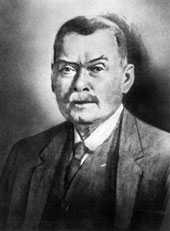 |
| Institution: | Disconto-Gesellschaft / Deutsche Bank | |
| Functions: | Joint Proprietor / Member of the Management Board 1902-1929 and Chairman of the Supervisory Board 1930-1942 |
For sixty years, Franz Urbig, who came from humble beginnings in Luckenwalde, Mark Brandenburg, was associated with Disconto-Gesellschaft and Deutsche Bank. After the early death of his father, Urbig began his professional career in 1878 as a clerk at the Luckenwalde District Court. Due to a lack of career advancement opportunities, he sought to join a private sector company, which he succeeded in doing in 1884 when he was hired by Disconto-Gesellschaft in Berlin, although in the first few years he had to content himself with simple tasks in the exchange office and the securities department. His privately pursued language studies alongside his work enabled him to take over the registry of the Chief Executive's office in 1889. In this capacity, Urbig was also involved in establishing the archives of Disconto-Gesellschaft. The founding of Deutsch-Asiatische Bank (DAB), under the leadership of Disconto-Gesellschaft, opened up interesting career opportunities for Urbig. At the end of 1894, he was granted power of attorney for DAB, traveled to East Asia, and in 1895 took over the management of the Tientsin branch. Here, together with the Hongkong and Shanghai Banking Corporation, he concluded the first Chinese bond issue, in which Germany participated. In 1896, he became a member of the DAB's Management Board. In 1897, Urbig returned to Berlin, but in 1898, Adolph von Hansemann sent him back to China to negotiate the founding of a German-Chinese railway company. During this stay, another DAB branch was established in Hong Kong with Urbig's assistance. In 1900, Urbig became Deputy Director of the newly established London branch of Disconto-Gesellschaft. His contributions to building Disconto-Gesellschaft's foreign business led to his appointment as a managing partner in 1902. Urbig had previously declined an offer from Deutsche Bank to join its Management Board. As a managing partner, he co-managed the executive office, which oversaw the departments of ongoing business. Until the First World War, Urbig primarily sought to incorporate his international experience into Disconto-Gesellschaft's foreign trade business. In addition to DAB, he served on the supervisory boards of Banca Commerciale Italiana, Compagnie Internationale d'Orient, Kongo-Eisenbahn, and Otavi Minen und Eisenbahn-Gesellschaft. Urbig played a significant role in establishing the German East Africa Company. The First World War, which led to the end of Germany's colonial aspirations and many foreign interests, meant that Urbig had to relinquish a large part of his previous responsibilities. In the 1920s, however, Urbig succeeded in reactivating some of the old international connections. In 1919, Urbig was involved as a financial expert in the preparations for the Treaty of Versailles. In numerous essays and lectures, he attempted, though largely in vain, to convince the victorious powers of the fatal economic consequences of the reparation demands. In 1923, he was chairman of the Currency Committee of the Central Association of German Banking and Bankers. As a member of the Administrative Board of Deutsche Rentenbank, he played a significant role in the introduction of the Reichsmark, which brought an end to inflation. In 1924, he was appointed to the newly formed General Council of the Reichsbank. At that time, he also participated in the founding of Deutsche Golddiskontbank. From 1927, Urbig held discussions with Oscar Wassermann about a possible merger of Disconto-Gesellschaft with Deutsche Bank. After the merger, Urbig retired as a managing partner in 1929 and served as Chairman of the Supervisory Board of the merged institution from 1930 to 1942, alternating at times with Max Steinthal and Oscar Schlitter. From 1942 until his death, he was Honorary Chairman of the Supervisory Board of Deutsche Bank. Through him, the "legacy" of Disconto-Gesellschaft remained effective for the longest time within the merged institution. His biographer Maximilian Müller-Jabusch characterized him as "a 'logician of business, a man of an unyieldingly precise working brain – with courage for responsibility'." Urbig, who was shaped by the international nature of banking before 1914, was largely uncomprehending of National Socialism. As Chairman of the Supervisory Board of Deutsche Bank and Disconto-Gesellschaft, he endeavored to ensure the continuation of business according to objective principles. He naturally could not prevent the displacement of Jewish board members in 1933/34, and in the case of Oscar Wassermann, he even believed he found professional reasons that justified a replacement.
Show content of Urwin, Jeffrey
| Biographical data: | 1956 |
| Institution: | Deutsche Bank |
| Functions: | Member of the Management Board 2016-17 |
Show content of Vallenthin, Wilhelm
| Biographical data: | 24.07.1909 in Hamburg - 15.12.1992 in Hamburg | 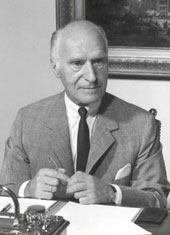 |
| Institution: | Deutsche Bank | |
| Functions: | Member of the Management Board 1959 - 1975 |
After graduating from high school in Hamburg, Wilhelm Vallenthin studied law and political science in Freiburg i.B. and Munich and passed his legal examinations in Hamburg. After a brief period at the Regional Court in Hamburg, he began his professional career at the Reich Ministry of Labour, most recently as a Senior Civil Servant (Oberregierungsrat). After the collapse of the "Third Reich", he transitioned from his career as a ministerial official to the management staff of Deutsche Bank in Hamburg in 1946, where he was active in syndicate business in the so-called Secretariat. When the management staff was dissolved, he initially moved to Wuppertal in 1948 and took over the management of various branches in the Wuppertal district. From 1950 to 1958, he worked in the Düsseldorf region, primarily in the syndicate business of the head office and as a member of the Cologne branch. During his time in Düsseldorf, he participated in the lifting of post-war legal restrictions on major banks, which was a legal prerequisite for the reunification of Deutsche Bank AG in 1957. In 1958, he was appointed Senior Group Director and from 1959 to 1975, he was a member of the Management Board of Deutsche Bank. In the Hamburg central region, he oversaw the branch districts of Hamburg, Braunschweig, and Schleswig-Holstein. Within the entire bank, he was responsible for legal matters, particularly contributing to the amendment of the Stock Corporation Act. He offered his advice as a Supervisory Board member at Volkswagen AG, Salzgitter AG, Norddeutsche Affinerie, Rudolf Karstadt AG, and Zeiss Ikon AG. Furthermore, he was involved in association work with the Federation of German Industries, the Confederation of German Employers' Associations, and the Association of German Private Banks.
Show content of Waller, Hermann
| Biographical data: | 04.01.1873 in Dinslaken - 03.03.1922 in Berlin |  |
| Institution: | Disconto-Gesellschaft | |
| Functions: | Joint Proprietor 1911 - 1922 |
Hermann Waller began his professional career in Duisburg, where he worked as a cashier at the banking house S. Meyer & Co. In the autumn of 1897, this company was transferred to the Duisburg branch of Rheinische Bank, which had been founded shortly before in Mülheim an der Ruhr with Leo Hanau as chairman and August Thyssen as deputy chairman. This institution conducted extensive international securities business, which suffered severe setbacks during the crisis of 1901. When the Duisburg branch was closed in connection with this, Waller moved to Mannheim, where, at an age when others were still in training and development, he joined the Management Board of Badische Bank, which at that time still operated as a central bank. Thanks to his energy, he succeeded in transforming a business operating with outdated methods into a modern banking enterprise. In 1905, Waller left Badische Bank to follow a call from Disconto-Gesellschaft to Berlin. On April 1, 1911, he was promoted to proprietor of the bank. His particular area of work lay in stock exchange business and central cash management. In addition, maintaining relationships with banks affiliated with Disconto-Gesellschaft was part of his sphere of activity. For example, he represented Disconto-Gesellschaft on the Supervisory Board of Süddeutsche Disconto-Gesellschaft in Mannheim, Allgemeine Deutsche Credit-Anstalt, and Bank für Thüringen, among others. Waller succumbed to a heart condition before reaching his 50th birthday. His son, Herbert Waller, was the representative of Deutsche Bank in New York from 1933 to 1938. Due to his Jewish descent, he did not return to Germany but remained in the United States. His brother, Gert Waller, who had worked for some time at Deutsche Bank in Berlin, left Germany in 1937, and in early 1941, his mother, Rosa Waller née Strauß, managed to emigrate to the United States. She later lived in Zurich and London, where she passed away in 1959.
Show content of Wallich, Hermann
| Biographical data: | 28.12.1833 in Bonn - 30.04.1928 in Berlin | 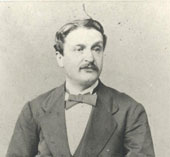 |
| Institution: | Deutsche Bank | |
| Functions: | Member of the Management Board 1870 - 1894 |
Hermann Wallich descended from an established Jewish family in the Rhineland. After an apprenticeship under Jacob Cassel in Cologne (1850-54) he moved to Paris to work for his uncle's bank Cahen d'Anvers (1854-60). Seeing no promotion prospects at Cahen d'Anvers Wallich switched to Trivulzi, Hollander & Co. (1860) and then to the Comptoir d'Escompte (1862) where he worked for its overseas branches including Réunion (1863), Shanghai and Yokohama (1867). So he was already an acknowledged expert on the overseas market when monetary policymaker Ludwig Bamberger approached him to recruit him for the new Deutsche Bank. Wallich consented and joined Deutsche Bank in October 1870. He found his vocation in building up the newly established Bank alongside the impetuous yet brilliant Georg Siemens. He was the ideal second in command in a company that sought to grow rapidly. His task was to rein others in, urge caution, express doubt, be a corrective force. He was the stabilizing element, holding Deutsche Bank together with his broad expertise in the economically unsettled environment of the bank’s early years and subsequently methodically pursuing its development into the leading major German bank. The bank’s major activities in East Asia and particularly in Latin America are unthinkable without him. It was under his aegis that Deutsche Bank opened branches in Bremen (1871) and Hamburg (1872) as well as in Shanghai, Yokohama (both 1872) and London (1873) and founded the Deutsche Uebersee Bank, the later Deutsche Ueberseeische Bank (1886). Wallich withdrew from day-to-day business comparatively early at 60, but remained involved with Deutsche Bank for the rest of his life as a member of the Supervisory Board. Management board member Max Steinthal characterized his colleague as follows: “For many long years he knew the daily status of its liabilities with each debtor, he didn’t need to consult the books ad hoc; he was always aware of things, in part by instinct, in part by seemingly browsing through the ledgers at random. His prodigious memory which stored all phases of complicated financial transactions in an orderly fashion, made him into a living compendium on Deutsche Bank.”
Show content of Wassermann, Oscar
| Biographical data: | 04.04.1869 in Bamberg - 08.09.1934 in Garmisch | 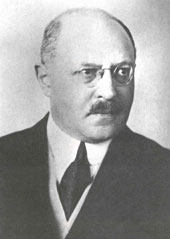 |
| Institution: | Deutsche Bank | |
| Functions: | Member of the Management Board 1912 - 1933 (Spokesman 1923 - 1933) |
Oscar Wassermann came from an established and respected Jewish banking family in Bamberg. He first learned the banking business in his father's bank and then built up its branch in Berlin. In 1912, Deutsche Bank appointed the now well-known expert in securities trading to the Management Board, where he was in charge of the stock exchange business. After the First World War, Wassermann's efforts were primarily directed at guiding the bank through inflation and the subsequent years, which were characterized by the tense situation on the capital markets. In the “Centralverband des Deutschen Bank- und Bankiergewerbes” (Association of German Bankers), Wassermann represented the interests of the banking industry as deputy chairman of the board. As Spokesman of the Management Board of Deutsche Bank Wassermann had a decisive influence on the merger of Deutsche Bank with Disconto-Gesellschaft in 1929. The world economic and banking crisis that soon set in showed that the merger was justified and that the solid capital base and high reserves gave the combined institution the necessary backing. After the National Socialists came to power, Wassermann's ousting from the Deutsche Bank Board of Managing Directors was only a matter of time, even though age-related reasons were officially given for his resignation. Even though he did not leave the bank until the end of the year, the Board of Managing Directors decided to announce his resignation before the Annual General Meeting in June 1933. Thereafter, Wassermann's health worsened rapidly and he died as early as the following year.
Throughout his life, Wassermann held on to his Jewish origins and took a great interest in the Zionist movement, for example with his support of the Palestine Reconstruction Fund "Keren Hajessod".
Show content of Weiss, Ulrich
| Biographical data: | 03.06.1936 in Bremen |
| Institution: | Deutsche Bank |
| Functions: | Member of the Management Board 1979-1998 |
Show content of Wendelstadt, Victor
| Biographical data: | 22.05.1819 in Linden - 15.07.1884 in Bad Godesberg |
| Institution: | Deutsche Bank |
| Functions: | Member of the Administrative Board 1870-1884 |
At the founding of Deutsche Bank in 1870, merchant and banker Victor Wendelstadt subscribed shares worth 141,000 thalers for the Cologne-based A. Schaaffhausen'scher Bankverein and also represented the banking house Deichmann & Co. as well as three other initial subscribers. Wendelstadt remained on the Administrative Board of Deutsche Bank from the first general meeting until his death in 1884.
Until 1874, Victor Wendelstadt was part of the two-member management board of A. Schaaffhausen'scher Bankverein; he then left office to become Gustav Mevissen's successor as head of the Supervisory Board. He was related by marriage to Wilhelm Ludwig Deichmann, the founder of the private bank Deichmann & Co., through his marriage to Deichmann's daughter Amelie. Wendelstadt had another personal connection to the Bank für Handel und Industrie in Darmstadt. This bank was founded in 1853 with the support of A. Schaaffhausen'scher Bankverein, and Victor's brother Theodor, who had also started his career at the Bankverein, became a director there.
Under the leadership of Wendelstadt and Deichmann, A. Schaaffhausen'scher Bankverein gained a leading role in financing banks and companies across various sectors and maintained a close relationship with the Rhenish-Westphalian mining industry. In 1929, A. Schaaffhausen'scher Bankverein merged into the combined Deutsche Bank und Disconto-Gesellschaft.
Show content of Wintermantel, Fritz
| Biographical data: | 26.04.1882 in St. Georgen - 25.07.1953 in Bühlerhöhe | 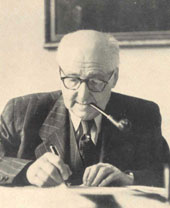 |
| Institution: | Deutsche Bank | |
| Functions: | Member of the Management Board 1933-1945 |
Like his fellow board members Rummel and Rösler, Fritz Wintermantel came from rather humble beginnings. His father ran a post office in the Black Forest, which lost its livelihood with the advent of railway traffic. In 1896, Wintermantel began an apprenticeship at Schwarzwälder Bankverein in Villingen, which he later continued in Triberg. Afterwards, he spent two years in Paris and London to expand his knowledge. At the end of 1902, he joined Deutsche Bank as a commercial assistant, initially working in the overseas department at the Berlin headquarters. There, he mainly dealt with acceptance credits and the business of the goods and sugar department. In 1912, he was granted power of attorney, and in 1917, he became departmental director. He was appointed deputy board member in 1927 and full board member in 1933. Wintermantel took over the management of the Berlin city headquarters, which consolidated the bank's very extensive deposit and credit business in the capital. Among the branches he supervised were the Hanseatic cities of Hamburg, Bremen, and Lübeck. Wintermantel's important mandates included the chairmanship of the supervisory boards of Orenstein & Koppel and Knorr-Bremse. At the end of the war, Wintermantel was the only board member remaining in Berlin who was not arrested by the Russians and was able to continue working at the headquarters, albeit under constant control. It was not until the spring of 1946 that he left Berlin and took over the management of the "Führungsstab" (Leadership Staff) Hamburg, which had been established at the beginning of 1945 as an alternative location in anticipation of future developments, to continue the tasks of the closed Berlin headquarters for the West German branches. When the Hamburg Leadership Staff was dissolved in 1948 due to the deconcentration of major banks in the British zone, Wintermantel joined the management board of the newly created Rheinisch-Westfälische Bank in Düsseldorf and, after its conversion into a stock corporation in 1952, took over the chairmanship of its supervisory board.
Show content of Zapp, Herbert
| Biographical data: | 15.03.1928 - 27.06.2004 | 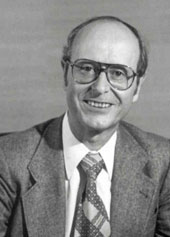 |
| Institution: | Deutsche Bank | |
| Functions: | Member of the Management Board 1977-1994 |
The doctor of law Zapp initially worked as a lawyer and subsequently as a civil servant in the Baden-Württemberg Ministry of Finance, before joining Deutsche Bank in 1960. After five years as co-head of the Ulm branch, he took over management of the Mannheim main branch. In 1972, he moved to the headquarters in Frankfurt, where he was tasked with establishing the Corporate Planning division. Five years later, in 1977, he was appointed to the Management Board, of which he was a member until 1994. On the Management Board, he was most recently responsible for corporate client business as well as the Legal and Tax Department; regionally, he oversaw the Düsseldorf branch district and, in international business, Latin America. He had a particular interest in the further development of corporate client business with medium-sized and smaller companies. Furthermore, for Zapp, who was involved in social and cultural activities in various ways, it was a special concern to bring art closer to employees in the workplace. He was the initiator of Deutsche Bank's art collection. For his commitment to business and culture, Zapp received numerous honors and awards, such as the Adam-Elsheimer-Preis.
Show content of Zwicker, Hermann
| Biographical data: | Unknown - 03.07.1885 |
| Institution: | Deutsche Bank |
| Functions: | Member of the Administrative Board 1870-1885 |
From 1870 until his death, Hermann Zwicker represented the Berlin banking house Gebr. Schickler on the Supervisory Board of Deutsche Bank, which had acquired shares worth 141,000 thalers when the bank was founded. Zwicker had already been a member of Deutsche Bank's founding committee, which drafted the statutes of the new institution and conducted negotiations with the Prussian state.
In Deutsche Bank's founding year, Zwicker became a partner at Gebr. Schickler (Schickler's share in Deutsche Bank's founding capital had been subscribed by his fellow partner Gustav Sonntag). The private banking house emerged from the trading house Daum & Comp., founded in 1712. The bank owned its own fleets of ships and traded in various goods such as sugar and colonial produce. An important part of its income came from the iron and war material trade for the Prussian state. Under the leadership of the Schickler family, who had taken over the company, not only the name but also the business orientation changed in 1795. The focus was now on banking. Over time, the Schickler family only held supervisory board positions, so the management of the bank lay with authorized signatories. These included members of the Zwicker family, who had been active in the company since the mid-18th century. In 1859, Hermann Zwicker, together with Gustav Sonntag, took over the position of manager. In 1870, Hermann Zwicker was promoted to partner to independently manage the business on behalf of the Berlin-based bank.
In addition to Deutsche Bank, Zwicker was also a member of the supervisory boards of other companies in which the banking house Gebr. Schickler held interests, particularly in the mechanical engineering industry and in mining and metallurgy.