Show content of Gebhard, Gustav
| Biographical data: | 18.08.1828 in Elberfeld - 06.05.1900 in Berlin |  |
| Institution: | Deutsche Bank | |
| Functions: | Member of the Administrative Board 1870-1900 |
The silk manufacturer Gustav Gebhard was the owner of the Elberfeld company Gebhard & Co., founded in 1797, then under the name Bernhard Cahen et Leeser, which produced, sold, and exported silk fabrics in particular, in addition to various other goods. The re-establishment under the name Gebhard & Co. took place in 1859 by Gustav's father Franz Josef. In 1886, the headquarters were moved from Elberfeld to Vohwinkel, both now districts of Wuppertal. Foreign trade was an important part of the company, and Gustav Gebhard, in his capacity as a merchant, travelled to various countries and established important international relations, especially with France, England, the USA, and the Orient. In 1868, he was appointed Persian consul.
Gebhard was also actively involved in founding banks; he was Chairman of the Supervisory Board of Bergisch Märkische Bank, which had been founded in 1871 by textile manufacturers, including Gebhard. Furthermore, he was a member of the Administrative Board of Barmer Bankverein and Deutsche Bank. There, until his death, he represented the interests of the textile industry in the Rhine-Ruhr region. He had subscribed 51,000 Thalers at its founding and had been elected to the first Administrative Board. Gebhard was among the personal circle of friends of Georg von Siemens. He spent his final years as a retired gentleman in Berlin.
Show content of Goldschmidt, Meyer
| Biographical data: | 14.05.1818 in Danzig - 1884 in Berlin |  |
| Institution: | Disconto-Gesellschaft | |
| Functions: | Joint Proprietor 1864-1868 |
Among the closest employees of David and Adolph Hansemann in the early days of Disconto-Gesellschaft was Meyer Goldschmidt, who received power of attorney in 1857 and was appointed proprietor after David Hansemann's death in 1864. As head of the management office, he was responsible for the day-to-day business, which included stock exchange and accounting transactions, securities trading, and the bill of exchange and deposit business. Goldschmidt's particular commitment was directed towards the latter business segment. For health reasons, he retired as proprietor in 1869 but remained associated with Disconto-Gesellschaft as a member of the administrative board until his death.
Show content of Gröning, Fritz
| Biographical data: | 28.03.1902 in Berlin - 16.09.1978 in Düsseldorf | 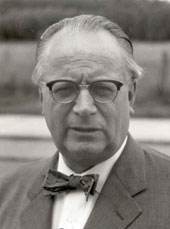 |
| Institution: | Deutsche Bank | |
| Functions: | Member of the Management Board 1953-1968 |
Gröning, who originally wanted to become an engineer and initially worked as a trainee in several mechanical engineering companies for two years after school, began an apprenticeship at Deutsche Bank's Berlin headquarters in 1922. In 1929, he went to London for a year to gain experience in English banking as a correspondent at Bankhaus Jacob Wassermann. In 1934, he was granted power of attorney, and from 1938, as a department head in the Secretariat, he handled Deutsche Bank's major syndicate business and the lending business of the Berlin city headquarters. After the end of the Second World War, Gröning continued to work at the Berlin headquarters until 1946, before joining Deutsche Bank's "management staff," which had relocated to Hamburg at the end of the war. In 1952, he became a director of Rheinisch-Westfälische Bank in Düsseldorf. From 1953 to 1956, he was a member of the Management Board of this successor institution of Deutsche Bank. After the re-establishment of Deutsche Bank, he served as a Management Board member there until his retirement. Even as a Management Board member, Gröning was particularly dedicated to promoting and fostering the issuance business. He also oversaw the branch districts of Bielefeld, Essen, and Siegen in the Düsseldorf area. The sales financing business, which was only modestly developed before the Second World War, was vigorously expanded by Gröning.
He contributed his expertise, among other things, as a member of the Capital Market Committee of the Association of German Banks. Gröning was Chairman of the Supervisory Board of Deutsche Centralbodenkredit AG, Deutsche Continental-Gas-Gesellschaft, and Knorr-Bremse AG, as well as Chairman of the Advisory Board of Gesellschaft für Absatzfinanzierung.
Show content of Guth, Wilfried
| Biographical data: | 08.07.1919 in Erlangen - 15.05.2009 in Königstein |  |
| Institution: | Deutsche Bank | |
| Functions: | Member of the Management Board 1968-1985 (Spokesman 1976-1985), Chairman of the Supervisory Board 1985-1990 |
After military service and as a prisoner of war (until 1949), Wilfried Guth studied economics at the Universities of Bonn, Geneva, Heidelberg, and the London School of Economics. In 1953, he joined the Bank deutscher Länder (since 1957, Deutsche Bundesbank). Five years later, he was appointed Head of the Bundesbank's Economics Department. In 1959, he went to the International Monetary Fund in Washington as a German Executive Director. Subsequently, from 1962 to 1967, he was a Member of the Management Board of Kreditanstalt für Wiederaufbau.
In early 1968, Guth was appointed to the Management Board of Deutsche Bank. From 1976 to May 1985, he served as Spokesman of this committee, together with F. Wilhelm Christians. The international issuance business was one of Guth's key areas of responsibility here, during a phase of increasing internationalization for Deutsche Bank. After leaving the Management Board, Guth served on the bank's Supervisory Board until 1995, and was its Chairman from 1985 to 1990.
During his time on the Management Board, he held Supervisory Board positions, often as Chairman or Deputy Chairman, in important German companies, including Daimler-Benz AG, Siemens AG, Allianz AG, and Philipp Holzmann AG. After leaving the Management Board of Deutsche Bank, Guth became a member of the Shareholders' Committee of Henkel KGaA and a partner of Robert Bosch Industrietreuhand KG.
As a currency expert, Guth was involved in numerous committees dealing with international monetary policy and intergovernmental economic relations. He was a member of the Board of Trustees of the Institute for Advanced Study in Princeton, the Group of Thirty, and the Comité pour l'Union Monétaire de l'Europe. In the 1960s, as a member of the Pearson Commission, he contributed to the formulation of a basic development policy concept on behalf of the World Bank and was European Co-Chairman of the Bretton Woods Commission in 1995. Guth also contributed extensively to the discussion on solutions for the international debt problem.
Corporate social responsibility was a central theme for Guth, and his free-market conviction was deeply rooted in his self-perception. For example, he played a leading role in the Society for the Promotion of Young Entrepreneurs, which organizes the "Baden-Baden Entrepreneurial Talks." In his view, a social market economy had to be more than just a set of rules for the functioning of the economy: "What makes it superior to all socialist and planned economy approaches was and remains the underlying intellectual and moral principle."
Guth was also involved in numerous cultural and scientific committees, including the Society of Friends of Bayreuth, the Friends of the Alte Oper Frankfurt, as an honorary member and patron of the Society for Corporate History and the European Association for Banking and Financial History.
Leading figures from politics and business can be found in Wilfried Guth's immediate family. His father, Karl Guth, served as Managing Director of the Reich Group for Industry from 1934 to 1945, and his uncle (from whom he received much inspiration) was Federal Minister of Economics and Federal Chancellor Ludwig Erhard.
Show content of Gwinner, Arthur von
| Biographical data: | 06.04.1856 in Frankfurt am Main - 29.12.1931 in Berlin | 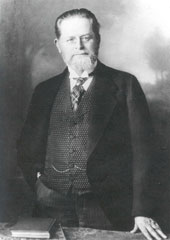 |
| Institution: | Deutsche Bank | |
| Functions: | Member of the Management Board 1894-1919 (Spokesman 1910-1919) |
Arthur von Gwinner came from a well-known family of Frankfurt lawyers. His father was executor of the estate of Arthur Schopenhauer, and his grandfather held the office of Senior Lord Mayor of Frankfurt. Following a banking apprenticeship with Mitteldeutsche Creditbank in Frankfurt am Main, he worked for a decade abroad (England, France, and Spain), where he acquired extensive knowledge of the international banking business. In 1888, he acquired the Berlin-based Bankhaus Riess & Itzinger, which he continued to operate under his own name but liquidated in 1894, when he was appointed member of the Board of Managing Directors of Deutsche Bank. In this capacity, Gwinner was primarily responsible for international operations and worked closely together with Georg von Siemens. An indication of how small the bank still was a quarter of a century after its foundation was that the two men still had desks facing each other, seeing as not every member of the Board of Managing Directors had his own room at that time. Siemens left the Board of Managing Directors at the end of the year 1900, and Gwinner took over his tasks, primarily relating to the major international transactions such as the Baghdad Railway and the railway financing in North America. The sale and restructuring of the Romanian crude oil company "Steaua Romana" marked the start of the establishment of the "oil group" at Deutsche Bank in the year 1903, an area for which Gwinner was also responsible. His name is also closely connected with the development of foreign business in the electrical industry, primarily with the foreign commitments of AEG and Siemens as well as their holding companies. Both the Baghdad Railway and the oil businesses of Deutsche Bank were economic and political undertakings that called for a great deal of diplomatic talent. In this context, Gwinner acquired a reputation as "the bank's diplomat", a responsibility for which he was especially suited by virtue of his cosmopolitan character and his excellent language skills. Although Rudolph von Koch initially held the Spokesman's position starting in 1901 - due to the seniority principle - Gwinner was considered to be Siemens' successor both internally as well as in the public eye when it came to the management of the bank and in his capacity as the executor of major foreign projects. The first fifty years of Deutsche Bank were decisively influenced by Siemens and Gwinner; both of whom were guarantors for the continuity of the company's development. January 1910, the Kaiser appointed Gwinner - for his services in the Ottoman Empire - member of the Prussian House of Lords, that is the "upper house" of parliament. This is where Gwinner held a famous speech in 1910 in which he criticized the budgeting as well as the deficit economy of the Prussian Finance Ministry, damaging to the government's credit. His famous remark during the debate: "Everything takes talent, but borrowing requires genius!" later became a frequently heard saying in Berlin. It was part of Deutsche Bank's "style", also maintained by von Gwinner, that the Spokesman of the Board of Managing Directors did not have any outstanding title. Gwinner therefore wrote to the "Berliner Tageblatt" on May 3, 1913 - "Confidentially and not for publication": "In reference to your report yesterday on the Bergmann annual general meeting, I politely request that you do not call me general director. Deutsche Bank has never had one and, as long as I am a member of the Board of Managing Directors, never will. Our Articles of Association are democratic." In 1919, Gwinner left the Board of Managing Directors and became member of the bank's Supervisory Board, functioning as its Deputy Chairman from 1923 until his death in 1931. In 1917 he donated 300,000 marks to benefit bank employees, which was used to establish a recreation home in the "Kraehenberg" section of Caputh, near Potsdam. In addition to banking, Gwinner's wide range of interests included, above all, mineralogy and botany.
Show content of Halt, Karl Ritter von
| Biographical data: | 02.06.1891 in Munich - 05.08.1964 in Munich | 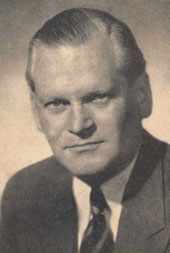 |
| Institution: | Deutsche Bank | |
| Functions: | Member of the Management Board 1938-1945 |
The son of an art locksmith began his professional career in 1908 as an apprentice at the Deutsche Bank branch in Munich and simultaneously attended the Luitpold-Oberrealschule, where he completed his Abitur in 1911. As a war volunteer, he was awarded the Max-Joseph-Ritterorden in 1917, which also entitled him to use the noble predicate.
Even before the First World War, von Halt's sports career had begun. Between 1911 and 1921, he was five-time German champion in the decathlon and placed eighth in this discipline at the 1912 Olympic Games in Stockholm. Financially secured as a sports teacher at the Munich Military Sports School, he earned his doctorate in 1922 at the Faculty of Economics of the University of Munich with a thesis on "The Cultivation of Physical Exercise at Universities. A Contribution to Regenerative Population Policy."
Returning to his learned civilian profession, he served as head of human resources at Bankhaus H. Aufhäuser in Munich from 1923 to 1935, which, due to its Jewish owners, soon fell under the restrictions of the National Socialists after 1933. Alongside this, he continued his career as a sports official, which reached its provisional peak in 1929 with his admission to the IOC. At the 1936 Winter Olympics in Garmisch-Partenkirchen, Halt served as president of the organizing committee, and as late as 1944, he (a member of the NSDAP since 1933) was appointed interim Reichssportführer.
When Deutsche Bank offered von Halt a director's position at its Berlin headquarters in 1935, this happened – although he had many years of banking experience and had even started his professional career at Deutsche Bank – primarily for tactical reasons. He was considered a prominent but not ideologically fanatical National Socialist, from whom the bank hoped to "tame" the party members within its own workforce who were proclaiming a "revolution from below." In the Management Board of Deutsche Bank, which he joined in 1938, he was assigned the human resources department. However, his influence on the actual banking business remained insignificant; for example, he held only a single supervisory board mandate.
Shortly after the end of the war, von Halt, who as commander of the "Reichssportfeld" Volkssturm battalion had participated in the battle for Berlin, was arrested by the Soviets and subsequently interned in the former Buchenwald concentration camp until early 1950 (his release, despite intervention from the IOC, only occurred upon the dissolution of the special camp). In contrast to his comeback as a top official in German sports (NOK President from 1951 to 1961), von Halt no longer held a leading position in the successor institutions of Deutsche Bank, which was dismantled until 1957. He merely served on the Supervisory Board of Süddeutsche Bank from 1952 to 1957.
Show content of Hammonds, Kim
| Biographical data: | 21.05.1967 Battle Creek (Michigan) - 28.06.2022 | 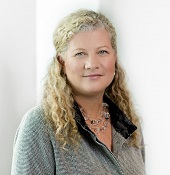 |
| Institution: | Deutsche Bank | |
| Functions: |
Member of the Management Board 01.08.2016 - 24.05.2018 |
Kim Hammonds had an MBA from Western Michigan University and a degree in mechanical engineering from the University of Michigan.
She held a number of management positions at Dell and Ford Motor Company, in product engineering, manufacturing, marketing and information technology leadership. Afterwards she was with Boeing from 2008 to 2013, most recently as Chief Information Officer (CIO).
Kim Hammonds joined Deutsche Bank in 2013 as a Global Co-Head of Group Technology & Operations. She became a member of Deutsche Bank's Management Board on 1 August 2016 as Chief Operating Officer & Group Chief Information Officer and was responsible for Technology and Operations, Information Security, Data Management, Digital Transformation and Corporate Services. She left Deutsche Bank in May 2018.
Show content of Hansemann, Adolph von
| Biographical data: | 27.07.1826 in Aachen - 09.12.1903 in Berlin | 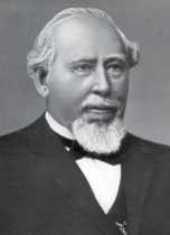 |
| Institution: | Disconto-Gesellschaft | |
| Functions: | Joint Proprietor 1857-1903 |
At the end of the 19th century, Adolph von Hansemann held a similarly central position for Disconto-Gesellschaft as Georg von Siemens did for Deutsche Bank.
Like his father David, Adolph Hansemann also showed an early and pronounced inclination for a mercantile career. After attending school in Aachen, he completed a commercial apprenticeship in Hamburg, Berlin, and Leipzig starting in 1841. At the age of seventeen, he became a partner in his cousin's cloth factory in Eupen. In 1857, his father appointed him as business owner at Disconto-Gesellschaft. While his father reserved the external representation of the bank for himself, the junior partner was initially responsible for organizing and managing the day-to-day business.
After his father's death in 1864, Adolph Hansemann succeeded him. He was now able to implement his own ideas and plans, adapted to the changed economic and political conditions. Hansemann became one of the most respected and energetic bankers of the Bismarck era. He transformed Disconto-Gesellschaft into Berlin's leading major bank. Under his management, the bank's share capital, which had been closely associated with Norddeutsche Bank in Hamburg since 1895, rose from 30 to 150 million Marks, and turnover expanded from 840 million in 1857 to 24.7 billion Marks in 1900. The syndicate formation of banks for the placement of large state or private issues, already pursued by David Hansemann, was further developed under Adolph.
During the Franco-Prussian War of 1870/71, Hansemann served as financial advisor to the Prussian government. It was thanks to his mission in London that a German government bond, specifically Prussian treasury bills used for war financing, could be placed on a foreign stock exchange for the first time. Hansemann's elevation to the hereditary Prussian nobility in 1872 was likely also a recognition of his services to German war finances.
After the founding of the German Empire in 1871, new fields of activity opened up for Adolph Hansemann. He systematically expanded relations with the West German mining industry. He served as Chairman of the Supervisory Board of Gelsenkirchener Bergwerks-AG since its founding in 1873. The Mengeder Bergwerks AG, which he restructured in 1896 and converted into a mining company, was named after him.
He also paid special attention to the further expansion of the railway network, in which his father had already been particularly involved. However, he now not only financed domestic railway facilities but also participated in numerous foreign railway companies. For example, he was a member of the administrative board of the Gotthard Railway Company and the Warsaw-Vienna Railway Company. Around 1890, together with Norddeutsche Bank in Hamburg, he financed the construction of the Great Venezuela Railway. Upon the founding of the Shandong Railway Company in 1899, he assumed the chairmanship of the supervisory board, which he held until his death. Already in the 1870s, Hansemann, together with the banking house Bleichröder, succeeded in restructuring the Romanian Railways of the "Railway King" Bethel Henry Strousberg, which were on the verge of collapse.
This period also saw the beginning of the friendship between Hansemann and the last owners of the banking house Mayer Carl and Wilhelm Carl v. Rothschild. The Frankfurt Rothschilds of the Carl line died out in 1901, and the Frankfurt firm was liquidated. Its place was taken by the Frankfurt branch of Disconto-Gesellschaft.
Hansemann supported Germany's colonial aspirations by founding the Deutsche See-Handelsgesellschaft (German Sea Trading Company), which prepared the acquisition of four Samoan islands by the German Empire. In 1885, he had established the Neu-Guinea-Compagnie (New Guinea Company). Under his leadership, the bank was involved in the development of foreign mineral resources in China through the Shandong Mining Company and in Southwest Africa through the Otavi Mining Company.
Around the turn of the century, he also integrated his institution into the Balkan business, where primarily the restructuring of the Romanian railways and their further expansion was undertaken. Together with Deutsche Erdöl AG, he provided the necessary capital for the development of the Romanian petroleum deposits.
Hansemann also showed particular initiative in the field of mortgage banking. After extremely difficult negotiations, in which Bismarck also showed keen interest, the Preußische Central-Bodenkredit-Aktiengesellschaft was founded in 1870, absorbing the Preußische Hypotheken-Aktiengesellschaft, which had been established in 1864. In addition, he participated in numerous bank foundings in other European countries and overseas.
Hansemann was one of the richest men of the German Empire; he was the epitome of the feudalistic bourgeois. He acquired estates in eastern Germany and built Dwasieden Castle on the island of Rügen. In total, he owned 7,000 hectares of land. Leading bankers and industrialists, statesmen, and diplomats from all over the world frequented his magnificent villa on Tiergartenstraße in Berlin. Political liberalism, which had an outstanding protagonist in his father David Hansemann, was not Adolph von Hansemann's concern. Like many industrialists and bankers of the German Empire, he was an enthusiastic supporter of Bismarck. Politically, he sympathized with the Free Conservatives, Bismarck's followers, who called themselves the "Deutsche Reichspartei" (German Imperial Party) at the national level.
further information
Show content of Hansemann, David
| Biographical data: | 12.07.1790 Finkenwerder - 04.08.1864 in Schlangenbad | 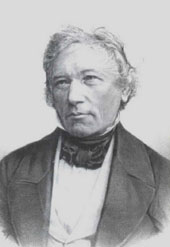 |
| Institution: | Disconto-Gesellschaft | |
| Functions: | Joint Proprietor 1851-1864 |
The founder of the Disconto-Gesellschaft is one of the most multifaceted personalities in German economic and financial history in the second third of the 19th century. It was only in advanced age that David Hansemann actively turned to banking. Until then, he had primarily been a merchant and politician.
He was born the youngest son of a large pastor's family. Already at the age of 14, he left his parents' home and became a commercial apprentice. As a clerk and traveler for the J. H. EIbers cloth and wool factory in Monschau and subsequently in his work for the firm H. Eller and Orth in Elberfeld, he acquired the knowledge that enabled him to become self-employed in 1817. In Aachen, he founded a commission business in wool with his savings of 1000 thalers. In 1821, he married Fanny Fremery, the daughter of a manufacturer from a French Huguenot family. His financial independence allowed him to increasingly devote himself to public affairs. After his election to the Aachen city council and the Aachen Chamber of Industry and Commerce, he began to increasingly address social problems. Thanks to his initiative, the Aachener Feuerversicherungs-Gesellschaft (Aachen Fire Insurance Company) was founded in 1824/25, a non-profit company that not only met the insurance needs of the broadest segments of society but also allocated a large part of its profits to worker and youth welfare.
As part of his social work, Hansemann founded the Aachener Verein zur Beförderung der Arbeitsamkeit (Aachen Association for the Promotion of Industry) in 1834, to which premium and savings banks, evening and Sunday schools, and day-care centers were later affiliated, and to which he always paid special attention. His restless spirit soon turned to new major tasks. Alongside Friedrich Harkort and Friedrich List, he was decisively involved in the development of the railway system in Germany. From 1835 to 1843, he served as president of the Rhenish Railway Company, which he co-founded. He also particularly strove for the construction of the railway between Cologne and Minden, which was extended to Hanover in 1847 and connected there to the already completed Hanover-Berlin line. Thus, the first railway line between the western provinces of Prussia and the capital Berlin was largely due to David Hansemann's initiative. Raising capital for these projects first brought him into closer business contact with well-known Cologne bankers.
As a representative of the liberal Rhenish bourgeoisie, to whose leading figures David Hansemann belonged, he increasingly distinguished himself as a publicist. In 1845, he was a member of the Rhenish Provincial Parliament, where he advocated, among other things, for the full equality of Jews and the abolition of aristocratic privileges. In 1847, he was delegated as a representative to the United Landtag in Berlin. The highlight of his political career was his appointment as Prussian Minister of Finance in the Camphausen cabinet in spring 1848. He retained this office under Prime Minister Auerswald but had to resign in September 1848 after another cabinet reshuffle – as his reform plans for the judicial, agrarian, and municipal constitutions increasingly came under fire from the feudal reaction. A short time later, due to his extensive experience in financial policy, he was appointed head of the Prussian Bank. In 1852, he declined another mandate for the Prussian House of Lords and, like many Old Liberals of that era, withdrew from political life. "He was a bourgeois of decidedly Western character, in ethos, achievement, and habits of thought, the exponent of a bourgeois leadership group in which the Prussian Junker party, with good instinct, saw its most dangerous opponent." (Erich Angermann)
Meanwhile, however, Hansemann had begun to dedicate himself entirely to a new task: the founding of the Direction der Disconto-Gesellschaft in Berlin, which commenced operations on October 15, 1851. David Hansemann had recognized that conventional forms of financing were insufficient to meet the growing capital requirements of industry and transportation.
In 1856, the Disconto-Gesellschaft was transformed from a credit cooperative into the more efficient legal form of a limited partnership with shares (Kommanditgesellschaft auf Aktien). This created the prerequisite for its further development into one of Germany's most important credit institutions, embodying a new type of bank and soon able to compete with international high finance even outside Prussia. Many of the banking policy methods and principles developed by Hansemann became groundbreaking for the entire German banking system.
With the Disconto-Gesellschaft's leading role in the so-called Prussian Consortium (which served to finance the Prussian mobilization), Hansemann was able to position his institution in the issuance business from 1859 onwards. He also paid particular attention to the deposit business. In addition to the trade and discount credit cultivated from the beginning, the bank also took up securities trading on its own account after the transformation in 1856.
David Hansemann remained, until his death, together with his son Adolph since 1857, the proprietor of the Disconto-Gesellschaft. It was only around the turn of the century that the Disconto-Gesellschaft had to cede its leading role in many areas of German banking to Deutsche Bank, with which it finally merged in 1929.
further information:
Show content of Hardt, Heinrich
| Biographical data: | 16.09.1822 in Lennep - 26.06.1889 in Berlin |
| Institution: | Deutsche Bank |
| Functions: | Member of the Administrative Board 1870-1889 |
The merchant Heinrich Hardt participated in the founding of Deutsche Bank with 47,000 thalers, which he acquired for his Berlin-based import and export company Hardt & Co. Until his death, he was a member of the Administrative Board.
His mother Luise came from the merchant family Hasenclever, and his father Engelbert Hardt was the owner of the textile company Johann Wülfing & Sohn, which had been founded in Lennep as early as 1674 and came into the possession of the Hardt family at the beginning of the 19th century. Heinrich was introduced to the merchant profession early on, so that at a young age, together with his younger brother Richard, he represented the paternal company in the USA. There, in 1847, the two founded the sales company Hardt & Co., which initially focused primarily on the import and export of textile goods from Johann Wülfing & Sohn. In 1854, a branch office was opened in Berlin, followed by others in Lyon, Verviers, Sydney, and various South American cities in Argentina, Bolivia, Chile, and Peru.
The many locations, the most important of which were New York and Berlin, meant that the brothers alternated their presence at these two places in three-year cycles. Heinrich and his wife Ottilie, née Bernuths, commuted between Europe and the USA and were members of the German Society in New York and involved in the German Life Insurance Company. There, he came into contact with other businessmen, several of whom also acquired shares in Deutsche Bank in 1870.
Show content of Hauenschild, Manfred O. von
| Biographical data: | 29.07.1906 in Leobschütz - 10.08.1980 Königstein (Taunus) | 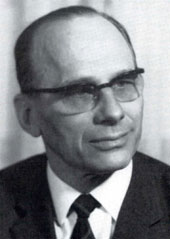 |
| Institution: | Deutsche Bank | |
| Functions: | Member of the Management Board 1959-1972 |
Before his law studies, von Hauenschild completed an apprenticeship with a Bremen cotton import company. After passing his second state examination in law, he began his professional career in 1934 as a legal counsel at Deutsche Centralbodenkredit AG in Berlin. From 1940 to 1945, he was a member of the Management Board of Mecklenburgische Hypotheken- und Wechselbank in Schwerin.
After the end of the war, he joined Deutsche Bank in 1946 and contributed to the reconstruction of the institution during the period of the regional successor banks; from 1952, he served as a Director with general power of attorney at Norddeutsche Bank. In 1959, he was appointed to the Management Board of Deutsche Bank, where he remained until his retirement. He primarily dedicated himself to organizational and legal tasks arising from Deutsche Bank's shift towards mass business from 1959 onwards, specifically savings and small loan business, as well as automation in the early phase of computer use at Deutsche Bank. Von Hauenschild summarized the changes that the broad entry into private customer business brought for the bank's operational processes in nine "Principles of Debtor and Creditor Mass Business."
As a regional executive, he was responsible for the Bavarian branch district. His important supervisory board mandates included the chairmanship of Bayerische Elektrizitäts-Werke, Bremer Woll-Kämmerei, and Deutsche Linoleum-Werke AG.
In the Association of German Banks, he served as head of the Competition Commission. In addition, von Hauenschild was a long-standing member of the Presidium of the German Protestant Church Congress.
Show content of Hecker, Emil
| Biographical data: | 1837 - 31.05.1915 in Berlin |  |
| Institution: | Disconto-Gesellschaft | |
| Functions: | Joint Proprietor 1869-1883 |
At the age of 21, Emil Hecker joined Disconto-Gesellschaft. After receiving power of attorney, he was responsible for the bank's stock exchange business. Following Meyer Goldschmidt's withdrawal from management, Hecker, along with Johannes von Miquel and Adolph Salomonsohn, was appointed as a managing partner. Even in this capacity, attending the stock exchange remained part of his duties until he – with the expansion of ongoing business – took over the management of the executive office. For stock exchange attendance, stock exchange directors were now appointed from among the authorized signatories. In 1883, Hecker retired from management due to illness, but remained a member of the administrative board (referred to as the Supervisory Board since 1885) of Disconto-Gesellschaft until his death.
Show content of Heinemann, Elkan
| Biographical data: | 17.01.1859 in Bayreuth - 19.09.1941 in Nice | 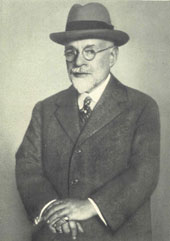 |
| Institution: | Deutsche Bank | |
| Functions: | Member of the Management Board 1906-1923 |
Of no member of the Deutsche Bank Management Board from the era of Georg v. Siemens and Arthur v. Gwinner is so little known as of Elkan Heinemann. He was with the bank for 38 years, 17 of which he was a member of the Management Board. Even at the height of his career, his contemporaries knew little about him. He lived behind his desk." (Fritz Seidenzahl) Elkan Heinemann's father was a teacher at the Israelite religious school in Bayreuth. After an apprenticeship, presumably in Antwerp and Brussels, he joined the secretariat of Deutsche Bank in Berlin in 1886. In 1893, he was granted power of attorney and soon after became head of the secretariat. From 1902 to 1905, he was deputy director; at the beginning of 1906, he was appointed to the Management Board of Deutsche Bank on the recommendation of Hermann Wallich. Heinemann was regarded on the Management Board more as the precise "scientist," a man of the second rank who tended to shy away from turbulent and risky business complexes. He shared responsibilities for foreign business primarily with Arthur von Gwinner. His commitment here was notably to the Deutsch-Überseeische Elektricitäts-Gesellschaft, founded in 1898. Among the seniors of the foreign business, he was the only one who remained active under the completely changed conditions after the First World War and was a member of the Management Board until 1923. Very early on, he had foreseen the decline of the German currency. After his departure, he moved to France, where he died during the Second World War.
Show content of Helfferich, Karl
| Biographical data: | 22.07.1872 in Neustadt - 23.04.1924 in Bellinzona | 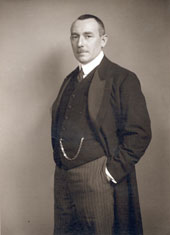 |
| Institution: | Deutsche Bank | |
| Functions: | Member of the Management Board 1908-1915 |
Karl Helfferich is primarily known for his role as a monetary politician, while his work as a banker outside Deutsche Bank is less remembered.
Helfferich came from an industrialist family in Vorderpfalz; his father owned a knitwear factory. After studying political science in Munich, Berlin, and Strasbourg, which he completed in 1894 with a doctorate in political economy (Dr. rer. pol.), he worked in Berlin as a scholar and journalist on topics such as monetary theory, currency issues, and – increasingly after the end of the First World War – politics (more than 150 titles). In 1899, he completed his habilitation on "The Reform of the German Monetary System after the Foundation of the German Empire". In 1901, he was appointed as a consultant for economic affairs in the Colonial Department of the Foreign Office. In 1903, his most significant study, concisely titled "Das Geld" (Money), was published. With this extensive work, which included historical and theoretical parts, Helfferich was recognized as one of Germany's leading monetary theorists.
In 1906, at the recommendation of Arthur von Gwinner, Helfferich took over the directorship of the Anatolian Railway Company and moved to Constantinople. There, after complex negotiations and the founding of the Baghdad Railway Company, he achieved the continuation of the Baghdad Railway's construction beyond the Taurus Mountains. In 1908, he returned to Germany and joined the Management Board of Deutsche Bank, to which he belonged until 1915. In addition to his responsibilities for the Baghdad Railway, Helfferich's interest primarily lay in Deutsche Bank's engagements in the colonial territories. His efforts to expand German-Belgian relations in Africa paid off for Deutsche Bank with extensive mining rights in Katanga and a significant stake in the Congo River Shipping Company. With the outbreak of the First World War, the colonial projects came to a standstill.
Helfferich resigned from the Management Board of Deutsche Bank in 1915 and, having been a member of the Reichsbank's Central Committee since 1911, was appointed State Secretary of the Imperial Treasury. In 1916/17, he served as State Secretary of the Interior and Vice-Chancellor under Imperial Chancellor Michaelis. The defeat of 1918 led to a political shift to the right for Helfferich, who, particularly during his time as a banker, had held rather liberal views. In 1919, he joined the German National People's Party. At the height of hyperinflation in August 1923, he presented a plan for creating a stable German currency ("Rye Currency"). Although the solution eventually implemented differed significantly from Helfferich's proposals, he was later referred to as the "Father of the Rentenmark". Despite being proposed by the Reichsbank Directorate as the new Reichsbank President, the Imperial Government decided against Helfferich and in favor of Hjalmar Schacht for the position at the end of 1923. Shortly thereafter, he became a victim of a railway accident.
Since 1920, Helfferich had been married to a daughter of Georg von Siemens and wrote the three-volume biography of Deutsche Bank's first CEO: "Georg von Siemens. Ein Lebensbild aus Deutschlands großer Zeit" (Georg von Siemens. A Portrait from Germany's Great Era).
Show content of Herrhausen, Alfred
| Biographical data: | 30.01.1930 in Essen - 30.11.1989 in Bad Homburg | 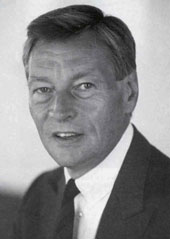 |
| Institution: | Deutsche Bank | |
| Functions: | Member of the Management Board 1970-1989 (Spokesman1985-1989) |
After his upper secondary school education, Herrhausen, who in his own words originally wanted to study philosophy, began his studies of business administration in Cologne in 1949. He graduated in 1952 as Diplom-Kaufmann and went on to obtain his doctorate as Dr. rer. pol. with a thesis on a subject in modern national economics. While he was preparing his doctoral thesis, he worked as Executive Assistant to the Management of Ruhrgas AG, Essen. In 1955 he moved on to become Executive Assistant at the Head Office of Vereinigte Elektrizitätswerke Westfalen AG (VEW) in Dortmund. As loan officer and financial analyst in New York he gathered foreign experience in banking during this period. In 1957, he received a limited power of attorney at VEW and general power of attorney two years later; at the same time he took over the commercial management at VEW's Head Office. In 1960 Herrhausen was appointed Director. He played a key role in preparing and executing the partial privatization of VEW in 1966. After completion of the project, he was appointed member of the Executive Board in 1967. Between 1956 and 1968, Herrhausen published numerous articles in trade magazines on issues concerning national and international power supply, corporate finance and company law. During this time, he was, among other things, assistant lecturer at the Dortmund Social Academy and in the Power Association's own training programme for energy economics, capital investment budgeting and industrial economics. Professionally, he was particularly interested in all questions of modern company management, especially costing, economic appraisal including investment budgeting and linear programming as well as company valuation. With effect from January 1, 1970, Herrhausen was appointed Deputy Member of the Board of Managing Directors by Deutsche Bank's Supervisory Board. He was responsible for international business in North and South America, Australia, New Zealand and South Africa, which was still an emerging economy at that time, as well as for foreign trade finance at the bank and economic questions; apart from that, he was responsible for the Essen Branch Region. In 1971, against the resistance of some of his colleagues, he obtained approval from Franz Heinrich Ulrich, Spokesman of the Board of Managing Directors, to build up a strategic planning system. The longer he was member of the Board of Managing Directors, the more supervisory board mandates devolved upon him as a matter of course. Tests of Herrhausen's abilities began with Stollwerck AG and Continental AG, two companies in need of reorganization. Later on, he assumed many other influential positions. In 1979 he showed interest in succeeding to Joachim Zahn as CEO of Daimler-Benz, a career step which he was unable to realize: "After all, Daimler-Benz is Deutsche Bank's biggest investment. I could have done things there. So it would have been in Deutsche Bank's interests as well." Nine years later, Herrhausen's influence saw SPD member Edzard Reuter appointed CEO at Daimler. The banker sought< "political" offices early on in his career. The Federal Minister of Finance appointed Herrhausen as member of the Study Commission "Fundamental Questions in the Banking Industry" (Banking Structure Commission), whose mandate was to examine the structure of Germany's banking industry and to make proposals to improve the banking sector. It was triggered by the collapse of the Herstatt Bank in 1974. The reform of the German Banking Act was based largely on the Commission's work. Later on, the German Federal Government commissioned him and two other "steel moderators" to produce a blueprint for restructuring the German steel industry; the plan was not successful. Herrhausen was a founder of the "Ruhr Initiative Group". He co-founded the "Action Committee for Europe", an association of influential European industrialists who supported the European integration process. He was also member of the Directorate of Germany's first private university in Witten-Herdecke. In 1985 Herrhausen was elected as one of the two Spokesmen of the Board of Managing Directors. He held this office together with F. W. Christians. He became sole Spokesman on May 11, 1988. "Power is something you also have to want," is one of Herrhausen's frequently quoted aphorisms. He understood the tenure of a leading position in business as an opportunity to assume a responsibility in and for the community. During his years in office, he raised many social and ecological issues. In view of the Third World's serious debt problems, Herrhausen was the first representative of a big bank to support debt forgiveness linked with economic reforms. His strong presence in the media gave him a high level of public visibility, previously unusual for a bank manager. On November 30, 1989, Alfred Herrhausen was the victim of a terrorist attack whose perpetrators are still unknown today.
Show content of Herz, Wilhelm
| Biographical data: | 26.04.1823 in Bernburg - 28.09.1914 in Berlin | 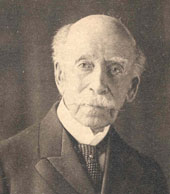 |
| Institution: | Deutsche Bank | |
| Functions: | Member of the Supervisory Board 1876-1889, Co-Chairman of the Supervisory Board 1889-1907, Chairman of the Supervisory Board 1907-1914 |
The senior head of the Berlin oil and rubber factory S. Herz, Privy Councillor of Commerce Wilhelm Herz, had been Chairman of the Supervisory Board of Deutsche Union-Bank in Berlin since its foundation in 1871 and joined the Board of Directors of Deutsche Bank after its liquidation in 1876. He was a member of this body for 38 years until his death, serving as Deputy Chairman since 1889 and as Chairman since 1907. He shared a close friendship with Georg von Siemens. He was a well-known personality in Berlin business circles and beyond, who provided the bank with numerous valuable connections. In addition to Deutsche Bank, he was on the Supervisory Board of Deutsche Ueberseeische Bank, Hypothekenbank in Hamburg, Schultheiss Brewery, of which he was also one of the founders, and Berliner Land- und Transport-Versicherungs-Gesellschaft. He played a crucial role in the development of the edible oil industry in Germany and was widely known as "Öl-Herz" (Oil-Heart). Furthermore, in 1869, he founded a rubber goods factory in Berlin. For decades, he was a member of the Council of Elders of the Merchants' Guild, serving as its President since 1895. In 1902, he was elected President of the newly founded Berlin Chamber of Commerce, thus, at the age of seventy-nine, taking the helm of Berlin's largest and first official economic representative body, which clearly highlights his special position in the economic life of the imperial capital. On his 90th birthday, he was the first merchant in Germany to be awarded the title "Excellency," which was otherwise reserved only for the highest officials.
Show content of Heydebreck, Tessen von
| Biographical data: | 09.01.1945 in Orth/Pommern |
| Institution: | Deutsche Bank |
| Functions: | Member of the Management Board 1994-2007 |
Show content of Heydt, Eduard von der
| Biographical data: | 30.05.1828 in Elberfeld - 04.07.1890 in Berlin |
| Institution: | Deutsche Bank |
| Functions: | Co-Chairman of the Administrative Board 1870-1887 |
Among the founders of Deutsche Bank, one would expect the name von der Heydt in connection with the esteemed banking house von der Heydt-Kersten & Söhne, but Eduard participated as a private individual and subscribed 63,400 thalers. He was involved in the planning process early on and was not only elected to the Board of Directors at the first general meeting but was also a member of the five-person committee that met weekly to coordinate business. On the Board of Directors, he also held the office of deputy chairman. The first financial advertisement of Deutsche Bank in the Frankfurter Zeitung on March 24/25, 1870, lists him as the owner of the company E. von der Heydt in Berlin, which has not left many traces in history. He left the banking house in 1887 due to internal disputes. Von der Heydt particularly rejected political activities of the board members and thus spoke out against the parliamentary work of the board spokesman Georg Siemens. However, Siemens prevailed, so von der Heydt eventually left the bank. As a member of the Board of Directors of Deutsche Bank, his focus, together with Delbrück, was on establishing Deutsche Bank's first branches.
The esteemed von der Heydt family had been elevated to the rank of Baron with Eduard's father August in 1863. August von der Heydt was not only a successful banker but also active as a parliamentarian and politician. Due to his political career, he retired from the banking business and left the management of the banking house von der Heydt-Kersten & Söhne to his two brothers, with Carl von der Heydt particularly distinguishing himself. Of August von der Heydt's sons, only the eldest was a co-owner of the bank, so Eduard, as the second-born, took a different path. He traveled to New York, married diplomat's daughter Alice Rosalie Schmidt there, and was appointed Prussian Consul himself. In the USA, he forged numerous connections, serving as a member of the board of directors of the German Life Insurance Company and the local German Society. Consequently, he had contact with other founders of Deutsche Bank, such as Hermann Marcuse, Heinrich Hardt, and Gustav Kutter, who were also elected to the Board of Directors. Due to his experience in the United States, he was involved in the bank's American business.
In his later years, Eduard von der Heydt resided in Berlin and was involved in company formations and financings, sometimes together with other leading figures of Deutsche Bank. Together with Georg Siemens and Hermann Wallich, he co-founded, among others, the Woll-Import Gesellschaft, and with Siemens, Delbrück, and Kutter, the Berliner Hotel- und Baugesellschaft. In the year of his death, he was elected to the Supervisory Board of the Disconto-Gesellschaft, a competitor of Deutsche Bank.
Show content of Hoeter, Joseph
| Biographical data: | 03.07.1846 in Münster - 02.05.1924 in Berlin | 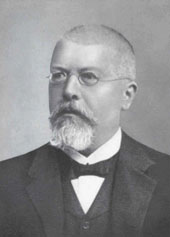 |
| Institution: | Disconto-Gesellschaft | |
| Functions: | Joint Proprietor 1900-1907 |
After studying law, Hoeter initially worked at the Ministry of Public Works in Berlin. Here he was promoted to Reporting Councillor and later to Secret Senior Government Councillor, eventually coming to Cologne as President of the Railway Directorate. From this position, Adolph von Hansemann brought him into the management of Disconto-Gesellschaft in 1900. In 1907, he moved to the management of the Schantung-Eisenbahngesellschaft, which was co-founded by the bank, to once again work as a railway expert, but remained a member of the Supervisory Board of Disconto-Gesellschaft until his death.
Show content of Hoops, Stefan
| Biographical data: | 1980 |
| Institution: | Deutsche Bank |
| Functions: | Member of the Management Board since 1 May 2026 |
Show content of Hooven, Eckart van
| Biographical data: | 11.12.1925 in Hamburg - 28.12.2010 in Hamburg | 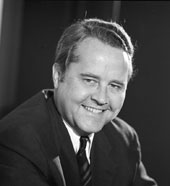 |
| Institution: | Deutsche Bank | |
| Functions: | Member of the Management Board 1972-1991 |
Eckart van Hooven, born in Hamburg, spent most of his school years in Berlin, where he completed his Abitur in 1943 and was subsequently drafted into the Wehrmacht. After the war, he initially pursued journalistic activities and worked temporarily for Sender Hamburg. In 1947, he began studying law in Hamburg (state examination for trainee lawyers in 1951, second state examination for fully qualified lawyers and doctorate in law in 1955). In 1955, he joined the Hamburg branch of Norddeutsche Bank, as the not-yet-reunited Deutsche Bank was then known. After one year, he became branch manager in the Hanseatic city, and soon after, co-head of the Hamburg-Harburg branch. In 1967, he became a director and three years later a Senior Group Director. In 1972, he was appointed to the Management Board of Deutsche Bank, to which he belonged until 1991.
Eckart van Hooven's name is closely associated with the development of the mass market business at Deutsche Bank, which began in 1959 with the introduction of the Personal Small Loan. Under Manfred O. von Hauenschild, van Hooven was entrusted with the organization of this new business segment; after his appointment to the Management Board, he was responsible for the personal banking business there. Van Hooven played a significant role in the development of the groundbreaking eurocheque for cashless payments, which was introduced in 18 European countries in 1969. He also drove Deutsche Bank's activities in the insurance and building society business.
His regional responsibilities as a Management Board member included Deutsche Bank's branch districts in the Hanseatic cities of Hamburg, Bremen, and Lübeck. Van Hooven particularly championed the economy of Northern Germany and close cooperation with the Scandinavian countries. In 1990, he took over the chairmanship of the Supervisory Board of Deutsche Maschinen- und Schiffsbau AG in Rostock, a holding company that emerged from the former Kombinat Schiffbau of the GDR.
During and after the end of his professional career, Eckart van Hooven was involved in Hamburg municipal politics.
Show content of Hunke, Heinrich
| Biographical data: | 08.12.1902 in Heipke/Lippe - 08.01.2000 in Hanover | 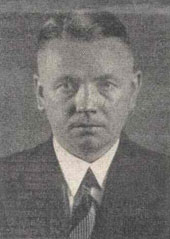 |
| Institution: | Deutsche Bank | |
| Functions: | Member of the Management Board 1944-1945 |
With the appointment of Heinrich Hunke to the Management Board of Deutsche Bank in September 1943, the bank yielded to the pressure, which had become evident since late 1942, to include another National Socialist in its leadership. Although Karl Ritter von Halt, a prominent party member, had already been on the Management Board since 1938, he, who always acted loyally towards the bank, was increasingly unable to fend off politically motivated attacks.
Unlike many members of the economic elite who joined the NSDAP out of opportunism, Hunke had joined the party out of conviction as early as 1928. He had originally trained as an elementary school teacher but then studied economics and received his Dr. rer. nat. in 1927. From 1927 to 1933, he worked as a research assistant and advisor in the Reich Ministry of the Reichswehr. In addition, since 1928, he served as the so-called 'Gauwirtschaftsberater' (District Economic Advisor) for the Berlin Gau of the NSDAP and founded "Die deutsche Volkswirtschaft" (The German Economy), the leading National Socialist economic magazine, in 1932. He had been a member of the Reichstag as an NSDAP deputy since 1932. In 1935, he was appointed honorary professor at the Technical University of Berlin. In 1933, Hunke was appointed Deputy President of the Advertising Council of the German Economy by the Reich Ministry of Public Enlightenment and Propaganda, a role that involved reorganizing the advertising sector. In 1939, he became President of the Advertising Council of the German Economy. Furthermore, in early 1941, as Ministerial Director, he took over the leadership of the Foreign Department of the Reich Ministry of Public Enlightenment and Propaganda, which was tasked with popularizing the concept of a European economic order under German leadership in the occupied states.
While Hunke had declined an offer to join the Management Board of Deutsche Bank at the end of 1942, half a year later he was so disappointed with his work in the Propaganda Ministry that he transferred to Deutsche Bank through the mediation of Reich Minister of Economics Walther Funk. After his succession in the Propaganda Ministry was settled, he joined the bank's Management Board on February 1, 1944. In the remaining year until the end of the war, he could not develop any significant business activities, but he rendered useful services to the bank in some critical conflict situations with the Nazi state.
At the end of April 1945, Hunke fled from the Red Army from Berlin to Hamburg, where he had to be dismissed from Deutsche Bank by order of the military government. After American captivity, Hunke managed to return to civil servant status in the early 1950s. He worked in the Lower Saxon Ministry of Finance, where he last held the rank of Ministerial Director.
Show content of Jain, Anshu
| Biographical data: | 07.01.1963 in Jaipur (India) - 13.08.2022 London |  |
| Institution: | Deutsche Bank | |
| Functions: |
Member of the Management Board 2009-2015 (Co-CEO 2012-2015) |
Anshu (Anshuman) Jain studied Economics at Shri Ram College in Delhi, graduating in 1983 with a Bachelor of Arts, and studied Business Administration at the University of Massachusetts, graduating in 1985 with an MBA in Finance. After his academic studies, he worked for Kidder Peabody, New York, in the area of Derivatives Research. From 1988 to 1995 he set up and ran the global hedge fund coverage group for Merrill Lynch, New York.
Jain joined Deutsche Bank in 1995 and became Head of Global Markets in 2001. He was appointed to Deutsche Bank's Management Board in 2009 and was responsible for the Corporate and Investment Bank division from 2010. From 2012 until 2015, he was, together with Jürgen Fitschen, Co-CEO of the Management Board.
Jain held, among many distinctions, an honorary doctorate from TERI University in New Delhi and an Honorary Fellowship from the London Business School.
Show content of Janberg, Hans
| Biographical data: | 17.04.1909 in Recklinghausen - 19.09.1970 | 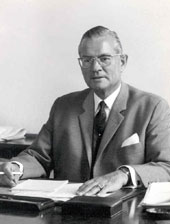 |
| Institution: | Deutsche Bank | |
| Functions: | Member of the Management Board 1957-1970 |
After studying law and serving as a judge at the Regional Court of Münster, the doctor of law joined Deutsche Bank's Freiburg branch as a trainee in 1936 and later moved to the Mannheim branch. After the war, he worked in various branches of Rheinisch-Westfälische Bank, where he was appointed to the Management Board in 1953. After the re-establishment of Deutsche Bank, he served on its Management Board until his death. His responsibilities included Human Resources, Chief Accounting, and the Economic Department, as well as the Düsseldorf and Münster branch districts. Important supervisory board mandates included the chairmanship at Hoesch and Gebr. Stollwerck. Janberg's great interest lay in the development of the working world, especially in the wake of rapidly advancing automation in large corporations. He dedicated himself intensively to employee development and training issues. His social study "Die Bankangestellten" (The Bank Employees), published in 1958, is considered a standard work in describing the social standing of this profession in the post-war era. After 1945, Hans Janberg was the first Chairman of the Employers' Association of the Private Banking Sector. Furthermore, he was a member of the Board of Trustees of the Society for the Promotion of Young Entrepreneurs.
Show content of Jentges, Wilhelm
| Biographical data: | 15.06.1825 in Krefeld - 16.06.1884 in Krefeld |
| Institution: | Deutsche Bank |
| Functions: | Member of the Administrative Board 1870-1884 |
Wilhelm Jentges was one of the Rhenish representatives of the textile industry on the Supervisory Board of Deutsche Bank, to which he belonged from the first meeting until his death. He was the son of Isaak Wilhelm Jentges and Anna Jentges, née von Beckerath, who belonged to a respected Krefeld entrepreneurial family. The family members owned various textile factories, including Jac. Von Beckerath Joh. Sohn, founded in 1841 by Jacob von Beckerath, of which Jentges became a partner. For this company, he acquired shares worth 37,600 Taler when Deutsche Bank was founded, and he also represented three other Rhenish textile companies. Jentges was also involved in other companies; from 1875, he was a member of the administrative board of A. Schaaffhausen’scher Bankverein and served on various Supervisory Boards of railway and industrial companies.
In addition to his commercial activities, Jentges dedicated himself to politics. He was active in Krefeld's local politics, and later in the Provincial Parliament of the Rhine Province. At the turn of the year 1882/83, he became his city's representative in the Prussian House of Lords.
Show content of Jonas, Paul
| Biographical data: | 19.02.1830 in Schwerinsburg - 21.01.1913 in Berlin |  |
| Institution: | Deutsche Bank | |
| Functions: | Member of the Management Board 1881-1887, Member of the Supervsiory Board 1887-1910 |
Paul Jonas came from a family that was originally Jewish. His grandfather, a merchant in Neustadt an der Dosse, had converted to Christianity in 1796. His son, Ludwig Jonas, studied theology under Friedrich Daniel Ernst Schleiermacher in Berlin, whose estate he later published, and during a longer stay in Schwerinsburg, he met Elisabeth Countess von Schwerin, whom he married in April 1829. He was active as a theological writer and emerged as a liberal politician. One of Ludwig Jonas's sons was Paul Jonas. After studying law in Berlin, Heidelberg, Halle, and finally again in Berlin, he initially became a government assessor in 1860 and subsequently president of the railway directorate in Berlin and Elberfeld. Probably influenced by his brother-in-law Adelbert Delbrück, who had been married to Luise Jonas since 1853, he resigned from his post in 1880. The private banker Delbrück, who is considered the actual initiator of Deutsche Bank, wanted to recruit Jonas for Deutsche Bank. On December 1, 1881, Jonas joined the Management Board of Deutsche Bank, which, as officially stated, was strengthened due to the "increase in share capital and the anticipated increase in work." Delbrück wanted to place him alongside Georg Siemens and, as Siemens himself suspected, groom him as his successor. Jonas primarily focused on railway financing, in which Deutsche Bank began to participate during these years. Particularly, involvement in the Northern Pacific Railway in the USA was on the agenda. However, the enterprising Siemens and the prudent, knowledgeable administrative official Jonas were too opposite in nature to work together in the long term. In 1887, a break occurred between the two. Paul Jonas resigned from the Management Board and joined the Supervisory Board, to which he belonged until 1910.
Show content of Kaiser, Hermann
| Biographical data: | Unknown |
| Institution: | Deutsche Bank |
| Functions: | Member of the Management Board 1872-1875 |
Show content of Kehl, Werner
| Biographical data: | 27.03.1887 in Bochum - 04.01.1943 in Hannover |  |
| Institution: | Deutsche Bank | |
| Functions: | Member of the Management Board 1928-1932 |
The son of a manufacturer joined the Deutsche Bank Düsseldorf branch in November 1919 after studying law, where he rose to director within a few years (1922). Kehl quickly attracted attention at the Berlin headquarters, having concluded a series of major deals in the Rhenish-Westphalian industrial region. By 1926, he became a deputy member, and in 1928, a full member of the Management Board of Deutsche Bank. His area of responsibility primarily involved fostering industrial relations in West Germany. Amidst the concentration movement of the late 1920s, Kehl achieved several spectacular transactions, such as the merger between Hammersen and Dierig to form Germany's largest cotton group, the creation of the Westwaggon Trust, and finally the integration of the Essen hard coal mines into Gelsenkirchener Bergwerks-Gesellschaft. However, the unsuccessful financing of Vereinigte Elektrizitätswerke Westfalen already weakened his position on the Management Board. The manipulations of a Düsseldorf branch director, who had embezzled millions, prompted Kehl – whose area of responsibility included the Düsseldorf branch division – to resign from the Management Board of Deutsche Bank in 1932.
Subsequently, he carried out a series of special economic assignments. In 1939, he was appointed General Director of Vereinigte Glaswerke Aachen (St. Gobain Group). In this capacity, he was also appointed Chairman of the Association of German Mirror Glass Manufacturers.
Werner Kehl died in a train accident in early 1943.
Show content of Kiehl, Johannes
| Biographical data: | 16.09.1880 in Carthaus - 20.05.1944 in Berli | 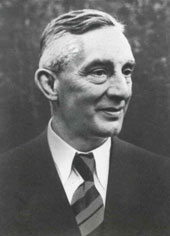 |
| Institution: | Deutsche Bank | |
| Functions: | Member of the Management Board 1938-1944 |
Kiehl – whose ancestors came from Masuria – was, like his father (Imperial Court Councillor Johannes Kiehl), a lawyer by profession. After attending the Domgymnasium in Naumburg, he completed a law degree in Munich and Berlin and, following his Assessor examination in 1906, joined the Secretariat of Deutsche Bank as a correspondent and legal officer. In 1909, he became an authorized signatory, in 1914 Deputy Director, and in 1926 Deputy Member of the Management Board. For many years, he headed the versatile secretariat business, which, in addition to processing large capital transactions, equity and bond issues, also encompassed a wide variety of other financing tasks. Even as a full Member of the Management Board (from 1938), Kiehl's interest continued to lie in the issuance and syndicate business. During the successful reorganization within the large Upper Silesian industrial groups after the First World War, Kiehl was able to apply both his commercial and legal skills. In the bank's ongoing business, he was responsible for the East German branches. Kiehl also established the business relationship with Reemtsma, and was significantly involved in the restructuring of Ufa and the merger of the locomotive factories "J.A. Maffei" and "Krauss & Comp." into "Krauss & Maffei".
Show content of Kimmich, Karl
| Biographical data: | 14.09.1880 in Ulm - 10.09.1945 in Berlin |  |
| Institution: | Deutsche Bank | |
| Functions: | Member of the Management Board 1933-1942 (Spokesman 1940-1942), Chairman of the Supervisory Board 1942-1945 |
Karl Kimmich initially completed an apprenticeship at a private bank in Ulm. After studying political science, which he completed with a doctorate, he joined the Berlin branch of A. Schaaffhausen'scher Bankverein in 1906, where he was primarily responsible for syndicate business. From Berlin, he moved to the head office in Cologne on January 1, 1915, and became deputy board member of A. Schaaffhausen'scher Bankverein in 1919 and full board member in 1921. Through his work in Cologne, Kimmich remained particularly connected to the Rhenish-Westphalian industrial region throughout his life and was considered one of its best connoisseurs.
When A. Schaaffhausen'scher Bankverein was absorbed into the new institution in 1929, as part of the merger of Deutsche Bank and Disconto-Gesellschaft, Kimmich resigned from the Management Board. However, Deutsche Bank continued to entrust him with significant special tasks, including the restructuring of Gebrüder Stollwerck and the difficult reorganization of Bergbau AG Lothringen.
"Dr. Kimmich possesses great constructive skill and the ability to think deeply about industrial issues, and has proven himself brilliantly in all positions he has held so far," described Management Board member Georg Solmssen in November 1932, referring to Kimmich's abilities.
These successes prompted Deutsche Bank to appoint Kimmich to the Management Board in Berlin in May 1933. Here, too, he again dedicated himself to large-scale industrial business, particularly the Rhenish-Westphalian mining industry. Numerous heavy industry companies secured his cooperation by appointing him to their supervisory boards. From 1940 to 1942, Kimmich was the Spokesman of the Management Board of Deutsche Bank. The Reichsbank gained his expertise by appointing him Chairman of its Credit Committee.
Karl Kimmich's relationship with National Socialism was certainly closer than that of most other older Management Board members. In the "Aryanizations" carried out by Deutsche Bank, his person within the Management Board was most prominent. A familial connection to the Nazi leadership was established by the marriage of Kimmich's brother to Joseph Goebbels' youngest sister. After Kimmich resigned from the Management Board in spring 1942 due to health reasons, he assumed the chairmanship of the bank's Supervisory Board until his death.
Show content of Klasen, Karl
| Biographical data: | 23.04.1909 in Hamburg - 22.04.1991 in Hamburg | 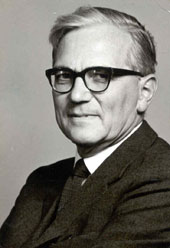 |
| Institution: | Deutsche Bank | |
| Functions: | Member of the Management Board 1952-1969 (Spokesman 1967-1969) |
Karl Klasen, son of a Hamburg shipping company employee, studied law from 1928 onwards. During his first semesters, he worked as a student trainee in the Port of Hamburg and as a tour guide for Hapag. After obtaining his doctorate (1933) and passing his assessor examination, he joined the legal department of Deutsche Bank und Disconto-Gesellschaft's Hamburg branch in 1935 as a legal counsel, where he worked until his conscription in World War II. Entry into civil service was out of the question for Klasen, who had joined the SPD in 1931, during the Nazi era.
After the end of the war, he returned to the Hamburg branch in July 1945, where he was appointed director in early 1948. Shortly thereafter, however, in April 1948, Klasen assumed the office of President of the Landeszentralbank in Hamburg for one term. In 1952, he returned to his former field of activity and was appointed to the Management Board of Norddeutsche Bank, one of the three successor institutions of Deutsche Bank. After its re-establishment, he joined the Management Board of Deutsche Bank in 1957, where he was responsible for the branch districts of Hamburg, Bremen, Hanover, and Osnabrück, as well as the advertising department.
Important supervisory board mandates for Klasen, whose particular focus was also on international business, included the chairmanship of Deutsche Bank subsidiaries Deutsch-Asiatische Bank and Deutsche Ueberseeische Bank, as well as Hapag and Howaldtswerke. Succeeding Hermann J. Abs, Klasen was entrusted with the role of Spokesman of the Management Board of Deutsche Bank in 1967, together with Franz Heinrich Ulrich.
In early 1970, Klasen succeeded Karl Blessing as President of the Deutsche Bundesbank. It was the first time in Deutsche Bank's hundred-year history that a personality from its ranks headed a central German central bank as its guardian of currency. He commented on his move from Deutsche Bank to the less well-paid position of Bundesbank President with the words: "Anyone who declines such an office does not deserve what life has given them so far." During his seven-and-a-half-year term – at a time when the Bretton Woods monetary system collapsed and the oil crisis erupted – Klasen consistently and successfully advocated for the stability of the DM and the autonomy of the central bank.
After leaving the office of Bundesbank President, Klasen was elected to the Supervisory Board of Deutsche Bank in 1978, where he served until 1984.
Karl Klasen was considered the epitome of a Hanseatic. His responsibility for the northern branch districts at Deutsche Bank and his close ties to international companies operating from Hamburg created a meaningful connection between his origin and his professional activity.
Show content of Kleffel, Andreas
| Biographical data: | 03.07.1916 Schwerin - 14.08.2003 | 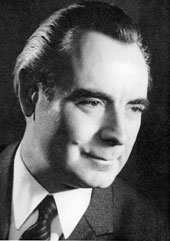 |
| Institution: | Deutsche Bank | |
| Functions: | Member of the Management Board 1963-1982 |
After passing his Abitur, Andreas Kleffel began studying law in Heidelberg and Hamburg in 1934. In 1938, he passed his legal clerkship examination, received his doctorate in law in 1939, and in 1941 – during an interruption of his military service – he passed the second state examination in law. After being discharged from military service, he became managing director of the then Reich Transport Group for Maritime Shipping in 1944, a sub-department of the Reich Ministry of Transport. Kleffel began his banking career shortly after the end of the war at Norddeutsche Bank in Hamburg, one of Deutsche Bank's successor institutions. He took on responsibilities in the Legal Department and the so-called Secretariat, where the consortium business was located. As early as 1954, he was appointed deputy director as head of these departments at the then head office of Norddeutsche Bank. As director, Kleffel joined the management of the Hamburg branch in 1956. After the merger of the three successor institutions of Deutsche Bank, he moved to the Düsseldorf head office in 1958 as Senior Group Director. There, in 1963, he was appointed as a deputy member of the Management Board. From 1967 to 1982, he was a full member of the Management Board. Kleffel was responsible for the Wuppertal and Krefeld branch divisions. His particular interest lay in the structural changes in modern banking. Within the Düsseldorf head office, he was responsible for mass market business, sales promotion, and the Legal Department. He also served on the Supervisory Board of several companies. For example, he was Chairman of the Supervisory Board of Girmes-Werke AG, Oedt near Krefeld, and Schiess AG, Düsseldorf, and Deputy Chairman of the Supervisory Board of Hugo Stinnes AG, Mülheim, and Rheinisch-Westfälische Boden-Credit-Bank, Cologne.
Show content of Klönne, Carl
| Biographical data: | 26.05.1850 Solingen - 20.05.1915 in Berlin | 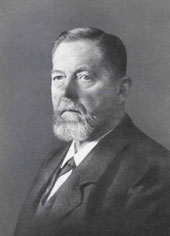 |
| Institution: | Deutsche Bank | |
| Functions: | Member of the Management Board 1900-1914 |
Coming from humble beginnings, Klönne had already risen to become director of Westfälische Bank in Bielefeld at a young age. In 1878, together with a younger colleague, he successfully restructured this institution, which had run into liquidity problems. One year later, he joined the Management Board of A. Schaaffhausen'scher Bankverein in Cologne. There, he primarily focused on industrial financing. Klönne soon realised that the financial needs of the Rhenish-Westphalian industry could not be met in the long term by the capital resources of this region alone. At his insistence, a branch was therefore established in Berlin, which he personally took charge of.
Around the turn of the century, Klönne was appointed to Deutsche Bank, initially to the Supervisory Board, and in 1900 to the Management Board. Here too, he was primarily involved in large-scale industrial business. He was particularly keen on promoting the equity issuance business, which until then had been somewhat overshadowed by Deutsche Bank's bond business. It was due to his initiative that Deutsche Bank and Essener Credit-Anstalt, whose Supervisory Board he had joined, worked closely together in syndicate business. This community of interest was reinforced in 1903 when Deutsche Bank acquired a block of shares in Essener Credit-Anstalt. This transaction marked the first step towards the takeover, which took place in 1925.
For health reasons, Klönne retired from the Management Board of Deutsche Bank in 1914. He was succeeded by Oscar Schlitter, who had already followed him from Essen to Berlin eight years earlier as a deputy Management Board member.
Show content of Koch, Rudolph von
| Biographical data: | 24.11.1847 in Gandersheim - 20.03.1923 in Berlin | 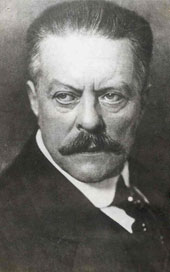 |
| Institution: | Deutsche Bank | |
| Functions: | Member of the Management Board 1878-1909 (Spokesman 1901-1909), Chairman of the Supervisory Board1914-1923 |
Rudolph von Koch joined Deutsche Bank shortly after its establishment in 1870. Already in 1872, he was promoted from authorized signatory to deputy director and was finally appointed to the Management Board in 1878. The focus of his work was on the bank's internal operations. Koch primarily directed his attention to current account and deposit business. However, the cultivation of these business segments could not be carried out from a single location; instead, it required a comprehensive branch organization, which Koch sought to establish.
Hand in hand with these efforts went Koch's endeavor to establish relationships between the headquarters in Berlin and various provincial banks. He served on the Supervisory Boards of important provincial banks, such as Bergisch Märkische Bank, Hannoversche Bank, and Schlesischer Bankverein. Deutsche Bank acquired all these institutions between 1914 and 1920, thereby gaining a significant branch network.
Koch was also active in international business. As a member of the Supervisory Board of Deutsche Ueberseeische Bank, he dedicated himself to the South American countries of Argentina, Chile, and Peru. Furthermore, Koch particularly fostered German-Turkish relations, both in economic, political, and cultural spheres. From the turn of the century, he headed the Turkish Consulate General for many years and was appointed Honorary Consul General by the Turkish government. In 1908, Koch was also elevated to the Prussian nobility.
After Georg von Siemens' withdrawal from the Management Board in 1900, Koch officially represented the bank externally, although even at that time, his fellow Management Board member Arthur von Gwinner was considered the company's true leading figure. In 1909, Koch resigned from Deutsche Bank's Management Board and moved to the Supervisory Board as Deputy Chairman. He chaired this body from 1914 until his death.
Show content of Kopper, Hilmar
| Biographical data: | 13.03.1935 in Osłonino (Poland) - 11.11.2021 Rothenbach/Westerwald |  |
| Institution: | Deutsche Bank | |
| Functions: | Member of the Management Board 1977-1997 (Spokesman 1989-1997), Chairman of the Supervisory Board 1997-2002 |
Kopper was born in 1935 as the son of an estate steward near Gdansk, in what is today Poland. After the end of the war, he moved with his family to Lower Saxony in northwestern Germany and graduated from high school in Cologne. A fatherly friend advised him at the time, "Do a bank apprenticeship, it won’t do any harm." So, in 1954, he joined the Cologne-Mülheim branch of Rheinisch-Westfälische Bank, as Deutsche Bank was known in North Rhine-Westphalia from 1948 to 1957.
Just one year after the end of his apprenticeship, the bank sent him to New York as a trainee, where he gained his first experience abroad at J. Henry Schroder Banking Corp. Back in Germany, he worked in the foreign department of Deutsche Bank's Düsseldorf office. In 1960, he moved to Leverkusen, where he took over as branch manager at the end of the decade. Two years later, Kopper was appointed board member of the then European Asian Bank in Hamburg, in which Deutsche Bank had a major stake. In 1975, he returned to Düsseldorf, by then a director with general power of attorney.
Kopper was not yet 42 years old when he joined the Management Board of Deutsche Bank in 1977. The construction between 1979 and 1984 of Deutsche Bank’s two towers in Frankfurt – the new headquarters – was one of the projects he oversaw. Soon he was also driving the bank's international development, with the acquisition of Banca d'America e d'Italia and Banco Comercial Transatlántico in Spain, followed by the acquisition of Morgan Grenfell in 1989, a deal on which he helped then Spokesman of the Management Board Alfred Herrhausen.
After Herrhausen’s assassination that same year, Kopper’s fellow Board members elected him as the new Spokesman within a few hours. He systematically continued with his predecessor’s plans for restructuring Deutsche Bank in Germany and abroad. After the fall of the Berlin Wall, Kopper expanded Deutsche Bank's banking business in the former East Germany. And under his leadership, Deutsche Bank succeeded in joining the ranks of the leading Anglo-American investment banks.
It was not just this reorientation of the bank that provoked criticism of him by the public; his straightforward, spontaneous way of saying things often had the same effect. The fact that Hilmar Kopper described the 50 million DM losses that contractors faced as a result of the collapse of the real estate company Schneider Group in 1994 as ‘peanuts’ was criticised by media and politics. At the same time, Kopper always remained down-to-earth and approachable for employees regardless of hierarchy.
Kopper unreservedly supported the bank's reappraisal of its past under National Socialism, which led in 1995 to the publication of Harold James' widely acclaimed study in the book "Deutsche Bank 1870-1995". He demonstrated just how important he believed the history of his own bank was by founding the Historical Association of Deutsche Bank in 1991.
After retiring from the Management Board in 1997, Kopper moved to the top of Deutsche Bank's Supervisory Board, which he chaired until 2002. At the same time, he served on the boards of a large number of German and international companies for more than a quarter of a century. In particular, from 1990 to 2007 he was Chairman of the Supervisory Board of the then Daimler-Benz AG and subsequently of DaimlerChrysler AG. He was also passionately committed to culture and academia, for example as the longstanding chairman of the Friends and Sponsors of Goethe University in Frankfurt.
more information
Show content of Krause, Stefan
| Biographical data: | 1962 |
| Institution: | Deutsche Bank |
| Functions: | Member of the Management Board 2008 - 31 October 2015 |
Show content of Krumnow, Jürgen
| Biographical data: | 18.05.1944 in Grünberg/Silesia |
| Institution: | Deutsche Bank |
| Functions: | Member of the Management Board 1988-1999 |
Show content of Krupp, Georg
| Biographical data: | 1936 |
| Institution: | Deutsche Bank |
| Functions: | Member of the Management Board 1985-1998 |
Show content of Kuhnke, Frank
| Biographical data: | 1967 |
| Institution: | Deutsche Bank |
| Functions: | Member of the Management Board 2019-2021 |
Show content of Kutter, Gustav
| Biographical data: | 01.06.1829 in Verviers - 21.01.1876 in Berlin |
| Institution: | Deutsche Bank |
| Functions: | Member of the Administrative Board 1870-1876 |
Gustav Kutter's connections to various industrialists, banks, and especially to the USA made him a key co-founder of Deutsche Bank. The merchant was a member of the committee that drove the establishment of Deutsche Bank and conducted negotiations with the Prussian state. Kutter himself participated as a private individual with 63,400 thalers and was elected to the Board of Directors by the first general meeting, which he belonged to until his death. As part of this body, he became a member of the weekly five-member committee, which included three delegates from the Board of Directors alongside the directors and coordinated Deutsche Bank's business.
Gustav Kutter was the proprietor of Kutter, Luckemeyer & Co., which had branches in Berlin, New York, Lyon, and Zurich and traded in haberdashery and textiles. His family had been active in the textile industry in Ravensburg, and Eduard Luckemeyer, co-proprietor of Kutter, Luckemeyer & Co., was the brother of Mathilde Wesendonck, who was married to the textile merchant Otto Wesendonck from Elberfeld and remained known as Richard Wagner's muse. Wesendonck, like his business partner Loeschigk, subscribed for shares in Deutsche Bank, whose voting rights they had Kutter represent. His excellent connections in the USA made Kutter an important founding member, as he was to help the bank gain a foothold in the American market. Kutter thus played a part in the founding of Knoblauch & Lichtenstein, which began its business as a limited partnership of Deutsche Bank in New York in 1872, by introducing Charles Knoblauch to the bank's leading representatives.
Show content of Lamberti, Hermann-Josef
| Biographical data: | 1956 |
| Institution: | Deutsche Bank |
| Functions: | Member of the Management Board 1999 - 31 May 2012 |
Show content of Leibkutsch, Hans
| Biographical data: | 30.03.1924 in Hamburg - 14.02.1979 in Paris |  |
| Institution: | Deutsche Bank | |
| Functions: | Member of the Management Board 1968-1979 |
After graduating from high school in 1942, Hans Leibkutsch, son of an auditor, immediately served in the war and was taken prisoner. In 1945, he began studying law in Hamburg, received his doctorate in law (Dr. jur.) in 1949, and passed his assessor examination in 1951. From 1951 to 1954, he worked as a lawyer in Hamburg. This was followed by a two-year banking apprenticeship and a position as head of the Executive Board Secretariat at Hermes Kreditversicherung. In 1958, he was appointed commercial board member to the management of Europa-Carton AG. In 1960, he joined the management of Deutsche Bank in Hamburg. In 1965, he was appointed Senior Group Director of the bank for the Düsseldorf central region. Three years later, he was appointed Deputy Member of the Management Board, and at the beginning of 1971, full Member of the Management Board. Within the entire bank, Leibkutsch was particularly responsible for foreign trade financing and cash management. Furthermore, he was responsible for the branch network in his hometown of Hamburg. His extensive experience in foreign trade financing benefited him as Chairman of the Supervisory Board of AKA Ausfuhrkredit-Gesellschaft. He served on the Supervisory Boards of major industrial, commercial, and shipping companies. He chaired this body at Hoesch AG, Dortmund, Mobil Oil AG in Germany, Hamburg, O&K Orenstein & Koppel AG, Berlin/Dortmund, and Phonix AG, Hamburg-Harburg. Additionally, he served for many years as Chairman of the East Asian Association in Hamburg.
Show content of Leithner, Stephan
| Biographical data: | 1966 |
| Institution: | Deutsche Bank |
| Functions: | Member of the Management Board 1 June 2012 - 31 October 2015 |
Show content of Lent, Alfred
| Biographical data: | 07.06.1836 in Berlin - 04.01.1915 in Berlin | 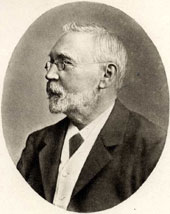 |
| Institution: | Disconto-Gesellschaft | |
| Functions: | Joint Proprietor 1878-1902 |
Alfred Lent is an example of a career changer in banking. He studied architecture, primarily under the Berlin master builder Eduard Hitzig – who, among other things, designed the facade of the old headquarters of Disconto-Gesellschaft in Behrenstraße and was chairman of the Berliner Immobiliengesellschaft, founded by Disconto-Gesellschaft in 1864. Lent won the Schinkel Prize, which funded a study trip to Rome, and subsequently designed a number of large buildings as an architect in Berlin, including the Lehrter Bahnhof (destroyed in World War II). His interest in railway construction led to contact with Adolph von Hansemann, who brought him into the bank after the Franco-Prussian War – in which he had participated as an officer – as a technical advisor for Disconto-Gesellschaft's numerous railway projects. In 1878, he became a managing partner. His field of activity remained the technical area in railway and industrial financing, as well as the planning and execution of new railway lines at home and abroad. He also played an important role in Disconto-Gesellschaft's bond business. After retiring from the management board, Lent remained a member of Disconto-Gesellschaft's Supervisory Board until 1914.
Show content of Leukert, Bernd
| Biographical data: | 1967 |
| Institution: | Deutsche Bank |
| Functions: | Member of the Management Board since 2020 |
Show content of Lewis, Stuart
| Biographical data: | 1965 |
| Institution: | Deutsche Bank |
| Functions: | Member of the Management Board 1 June 2012 - 19 May 2022 |